Cognitive Games That Actually Make You Smarter
Let’s be honest, most so-called “brain games” are more about killing time than actually improving your mind. You’ve probably seen a bunch of flashy apps promising to make you smarter in just a few minutes a day. But if you’ve ever played them, you know the truth - they’re either too easy or they don’t really make you think.
But here’s the good news: some cognitive games really do help you get smarter. Not in a “suddenly become a genius” way, but in a real, noticeable way - sharper focus, faster thinking, and better memory. That’s what good brain training is all about.
If you’ve ever wondered which games actually work, or what makes one brain app better than another, this guide will break it all down. And if you’re serious about giving your brain a daily challenge, Moadly is a great place to start. It’s built around quick, simple games that train your mind in small, consistent bursts.
So... Can Games Really Make You Smarter?
Yep, they can - but not just any games. The ones that help are designed to push your brain to adapt and solve problems, kind of like lifting weights for your mind. This process is called neuroplasticity. It’s how your brain forms new connections and gets better at processing information.
When you play well-designed cognitive games, you’re basically teaching your brain to work more efficiently. That’s why after a few weeks of consistent training, people often notice they can focus longer, remember things faster, and think more clearly.

What Makes a Cognitive Game “Good”?
A real cognitive training game isn’t just random tapping or guessing. It makes you use your brain’s core functions - memory, logic, attention, and problem-solving. The best games:
- Get harder as you improve, so you never plateau
- Train multiple areas of the brain, not just one skill
- Are short, focused, and rewarding to play
- Give feedback so you can see progress
That’s the exact formula Moadly uses. Each mini-game is short, fun, and designed to make your brain actually work. You can play for 10 minutes a day and still feel the effects - sharper recall, faster responses, and more focus.
Different Types of Cognitive Games (and What They Do)
Here’s a quick breakdown of the main types of cognitive games that really train your brain, plus what each one improves:
| Game Type | Trains | Real-World Benefit |
|---|---|---|
| Memory Games | Working and short-term memory | Improves recall, focus, and organization |
| Logic and Reasoning Games | Critical thinking and pattern recognition | Helps with problem-solving and decision-making |
| Math and Calculation Games | Numerical reasoning and processing speed | Boosts mental agility and concentration |
| Attention Games | Selective focus and reaction time | Improves multitasking and alertness |
| Language and Word Games | Verbal reasoning and comprehension | Expands vocabulary and communication skills |
You’ll find all of these in Moadly, which means you’re not stuck playing one type of challenge. You can switch from a logic puzzle to a math test in seconds, keeping your brain on its toes.
Memory Games That Really Work
Memory is one of the easiest areas to train - and one of the most rewarding. Games that make you remember patterns, numbers, or sequences train your working memory. That’s the system your brain uses to hold and manipulate information in real time.
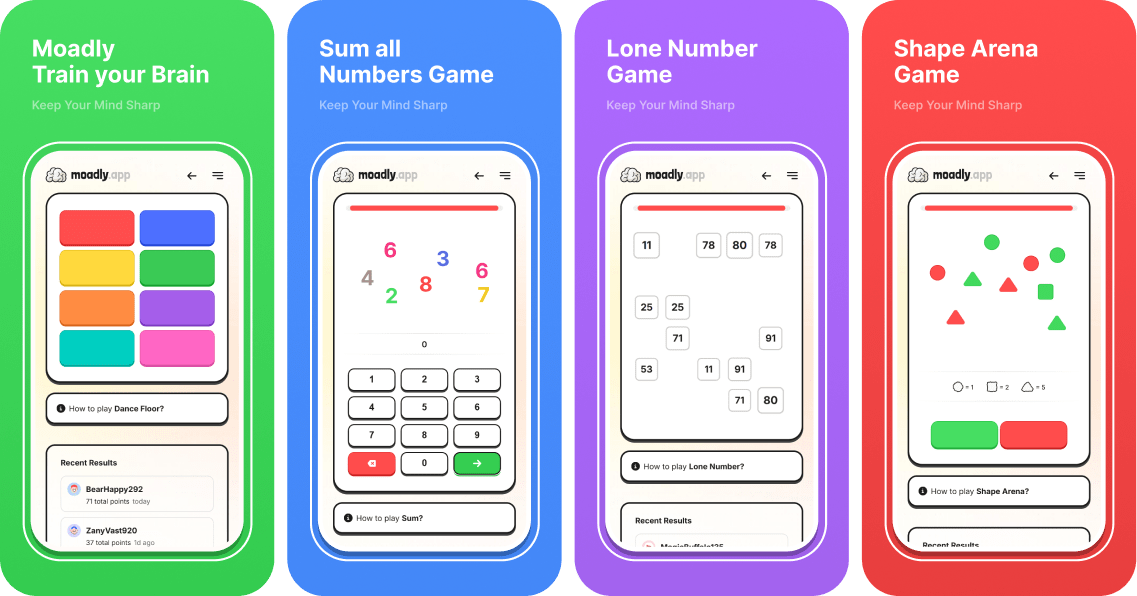
In Moadly, there are several quick memory challenges. For example, one mini-game flashes symbols or numbers for a few seconds, and you have to recall them in order. It sounds simple, but your brain gets better at it the more you play.
If you want to dig deeper into how memory training helps with focus and mental clarity, check out this article on how mental exercises can clear brain fog.
Logic and Reasoning Games
Logic games are perfect for developing smarter, more strategic thinking. These include puzzles that make you analyze relationships, patterns, and sequences. Sudoku, logic grids, and pattern games are classic examples.
Apps like Moadly take this a step further with bite-sized logic games that adapt as you improve. They force your brain to slow down, think critically, and find efficient solutions. Over time, that kind of thinking carries over into real life - better problem-solving at work, school, or daily decision-making.
If you enjoy challenges like this, you’ll probably like these puzzles for adults that are both fun and mentally stimulating.
Math and Number Games for Focus
Math games aren’t just for kids - they’re one of the fastest ways to train focus and mental speed. When you do quick calculations, your brain works hard to process data, hold numbers in memory, and find the answer - all under time pressure.
That’s why Moadly’s math challenges are so effective. You only get a few seconds to solve each problem, and as you get better, it gets faster. It’s like sprinting for your brain.
If you want to see how math games can actually help with cognitive growth, take a look at this post that breaks down how math play builds real learning habits.
Attention and Reaction Games
One of the biggest signs of a strong mind is focus. Games that test your reaction time or selective attention train your brain to stay alert and process information faster. You’ll start noticing improvements not just in games, but in how quickly you respond in everyday situations.
Moadly’s attention games often give you visual cues that appear and disapear in seconds. You have to tap or respond at the right moment. It’s like teaching your brain to react faster without panicking.
If you’ve been struggling to focus due to fatigue or brain fog, this article explains simple ways to regain mental clarity fast.
Word and Language Games
Language-based games are another great tool for brain growth. They challenge vocabulary, comprehension, and lateral thinking - which means your brain starts connecting ideas more creatively.
Moadly’s quick word puzzles test recognition and pattern spotting rather than rote memorization, which keeps things light and engaging. These small exercises train your brain to think faster with words and improve communication overall.
If you’re into this kind of mental stretching, check out these learning games for kids that are surprisingly fun even for adults.
How Often Should You Play?
Consistency is everything. You don’t need to train for hours - in fact, short, focused sessions work better. Most research says 10–15 minutes a day is enough to see real improvement. The key is to make it a habit.
That’s what Moadly is built for. It’s not about grinding levels for hours. It’s about daily brain sprints - small moments of focus that slowly build up your cognitive strength.
Why Cognitive Games Work Better Than Passive Learning
When you passively consume information, like watching a video, your brain doesn’t have to work much. But when you play a cognitive game, you’re forced to react, think, and adapt - thats what triggers neuroplasticity.
Games that challenge memory, speed, and logic all engage your prefrontal cortex - the part of your brain responsible for planning, focus, and reasoning. The more you use it, the stronger it gets.
Combining Games for Maximum Benefit
Instead of focusing on just one type of game, try combining different challenges. For example:
- Start with a memory game to warm up
- Then move to a math challenge for focus
- Finish with a logic puzzle to cool down
This gives your brain a balanced workout. Moadly actually does this automatically - it rotates game types so you get variety without having to plan it yourself. If you want to learn how daily training routines can keep your mind sharp, see this article on why consistency matters for mental health.
Do Cognitive Games Really Improve IQ?
Technically, they don’t raise your IQ score overnight. But what they do is improve the underlying skills that influence IQ - like working memory, attention, and problem-solving. That’s why researchers often say “you can’t change your IQ, but you can improve the skills that support it.”
If you’re curious which games are best for actual IQ improvement, this article on which game increases IQ the most breaks it down in detail.

What to Avoid
Not every “brain game” helps. Avoid apps or websites that:
- Use repetitive, mindless tapping or guessing
- Never increase difficulty
- Rely on gimmicks instead of challenge
- Don’t show progress or results
A real brain training app keeps you mentally active and slightly uncomfortable - that’s the sign you’re learning. Moadly nails this balance perfectly.
Final Thoughts
Smart doesn’t mean knowing everything. It means being able to think clearly, react quickly, andadapt easily. Cognitive games help you build those exact skills through repetition, challenge, and fun.
So if you want to give your brain a workout that actually matters, start small. Play a few short games every day. Mix it up. Track your progress. And most importantly, make it fun. Because when it’s fun, you’ll actually stick with it.
That’s what Moadly is all about - short, fast-paced games that challenge your focus, logic, and memory without feeling like homework. You can start anytime, and every minute you play makes your brain just a little bit stronger.
Want more ways to sharpen your mind? You might like these quick focus games or explore how brain training apps really help. Whichever you pick, the important part is this - keep your brain active. Because when you do, everything else in life starts working a little smoother too.