Math Games That Make Learning Fun Again
Remember when math felt like a chore? For a lot of us, numbers, equations, and word problems bring back memories of confusion or stress.
But what if math could actually be fun? What if you could practice addition, subtraction, and patterns without ever feeling bored or overwhelmed?
That’s exactly what Moadly and other well-designed math games do. They take the dry, repetitive side of math and turn it into something interactive, fast-paced, and actually enjoyable. You end up learning without even realizing it, which is the magic of a well-crafted game.
Why Traditional Math Learning Can Be Tough
Most people experience one or more of these problems when learning math the old-fashioned way:
- Long worksheets that feel endless
- Abstract concepts with no real-world connection
- Little to no feedback until it’s too late
- Pressure from time limits or grading
These methods can make even simple math stressful. That’s why games are such a game-changer. They break math into bite-sized pieces, give instant feedback, and reward your brain for progress. Even a few minutes of daily play can start building real skills.
If you want more ideas for turning short, fun exercises into meaningful learning, check out Fast-Paced Brain Training Games to Boost Focus.
What Makes a Math Game Truly Fun
Not every game labeled “math” actually teaches math. A fun and educational math game shares a few important qualities:
- Interactive: The game requires active thinking, not just tapping or guessing.
- Progressive: Challenges grow with your skill, keeping you engaged.
- Rewarding: Instant feedback or mini-achievements keep motivation high.
- Variety: Multiple types of challenges prevent boredom.
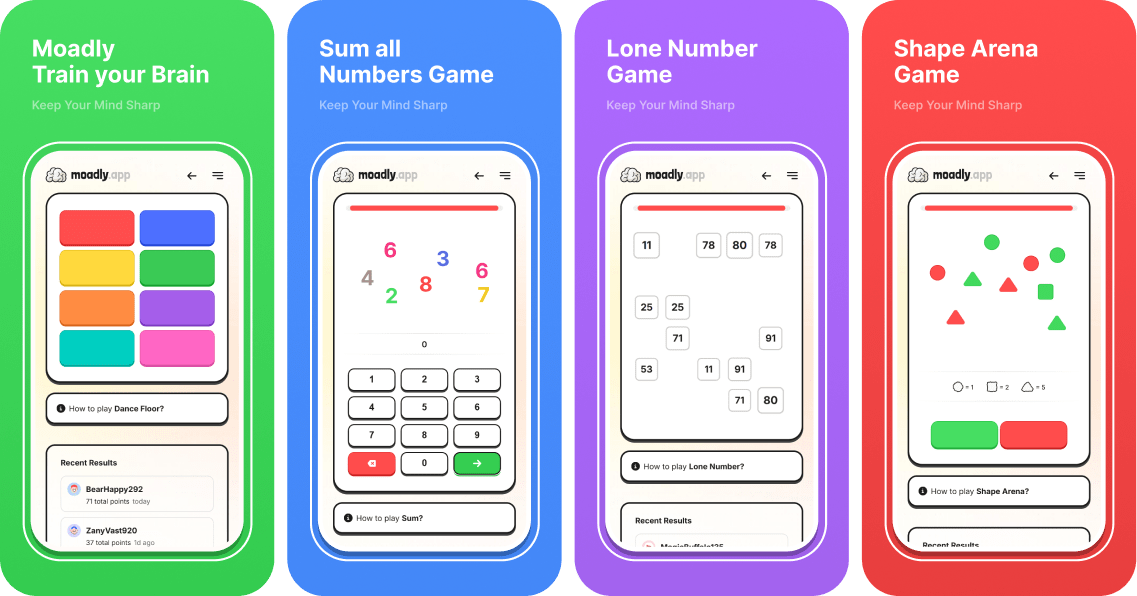
Moadly hits all of these points. You can play memory-based number games, quick arithmetic challenges, pattern puzzles, and more, all in one app. Switching between these game types keeps your brain engaged while strengthening multiple cognitive skills at once.
Top Skills Built by Math Games
Fun math games don’t just improve your arithmetic. They train a whole range of mental skills that help in school, work, and everyday life:
| Skill | How Math Games Help |
|---|---|
| Working Memory | Remember numbers and sequences, which helps with more complex math later |
| Focus & Attention | Games require concentration, which improves mental clarity |
| Problem-Solving | Logical thinking is practiced with patterns, sequences, and puzzles |
| Processing Speed | Quick calculations increase your mental agility |
| Confidence | Instant feedback and small wins build a sense of achievement |
When you combine these skills, you’re not just “getting better at math.” You’re improving your brain’s overall capacity, which also helps with memory, focus, and reasoning in daily life. If you want to see more ways brain training improves focus and mental sharpness, check out How Daily Brain Training Supports Mental Sharpness.
Types of Math Games That Make Learning Fun
1. Rapid-Fire Arithmetic
These games show a series of quick addition or subtraction problems, and you answer under a short time limit. It sounds simple, but it trains processing speed, accuracy, and focus simultaneously. Moadly’s version is addictively fast and gradually increases in difficulty to match your growing skills.
2. Pattern Recognition
Pattern games are a huge part of math learning. You see a sequence like 2, 4, 6, ? and have to fill in the next number. This trains logic, prediction, and mental organization. Moadly mixes visual and numeric patterns to keep it engaging. If you want more puzzle-based mental challenges, check out Best Puzzles for Adults Who Love a Challenge.
3. Number Memory Challenges
Remembering numbers is a surprisingly powerful skill. Games might flash a number sequence briefly and ask you to recall it. Moadly’s memory games combine numbers with fun visuals, turning a potentially dull exercise into a game you actually want to play.
4. Math Mazes
These are interactive puzzles where you solve small problems to progress through a maze. It combines problem-solving, pattern recognition, and arithmetic. Completing a level feels like a mini victory, which keeps beginners motivated.
5. Visual Counting Games
Instead of traditional equations, you count objects or groups of items. This strengthens number sense and helps beginners connect numbers with real-world quantities. Kids especially enjoy this type of game, which makes math feel tangible.
Why Moadly
Moadly isn’t just a math game, it’s a complete brain training tool. Here’s why it works better than traditional drills or other apps:
- Mixes math, memory, logic, and pattern challenges in short bursts
- Adapts automatically to your skill level
- Rewards progress, not perfection
- Perfect for quick sessions during breaks or before bed
It’s also ideal for families. Kids can start with number matching or counting games, while adults can practice rapid arithmetic or complex sequences. Everyone can improve without feeling bored or pressured. If you want a guide for beginner-friendly learning games, see Best Learning Games for Kids That Actually Teach Something.
Building a Daily Routine
Consistency is key. You don’t need hours of play, 10–15 minutes a day is enough. Here’s an easy routine for beginners:
- Morning: Quick number memory game to wake up your brain
- Afternoon: Rapid-fire arithmetic challenge
- Evening: Pattern recognition or visual counting game
This kind of routine turns daily play into a habit that reinforces learning while keeping it fun. Moadly’s automatic rotation of mini-games makes this effortless.
Tips for Parents and Educators
- Start with short sessions, don’t overwhelm beginners
- Celebrate small wins to boost confidence
- Mix different types of games to train multiple cognitive skills
- Encourage self-paced learning, everyone improves at their own speed
- Use games like Moadly to track progress and see improvement over time
If you want more ideas for helping kids enjoy math at home, check out Fun Math Games for 4th Graders to Practice at Home.
Common Mistakes Beginners Make
- Skipping foundational skills and jumping into advanced challenges
- Playing only one type of game, leads to plateaus
- Getting discouraged by mistakes, feedback is meant to teach
- Playing for long stretches without breaks, attention fades
Math games work best in short, focused bursts with gradual skill progression. That’s exactly how Moadly structures its mini-games.
The Mental Benefits Beyond Math
Math games don’t just make you better at numbers. They also:
- Improve concentration and focus
- Boost working memory
- Strengthen problem-solving skills
- Increase confidence in learning new skills
These benefits are noticeable in school, work, and daily life. Kids who play regularly show faster mental recall and adults notice sharper decision-making. If you’re interested in the cognitive science behind it, see Understanding the Cognitive Benefits of Brain Training Apps.
Thoughts
Math games are one of the easiest ways to make learning enjoyable again. They replace stress with curiosity, repetition with variety, and confusion with confidence. And the best part? You don’t need to spend hours. Even 10 minutes a day can start transforming your brain’s ability to process numbers, spot patterns, and solve problems.
Apps like Moadly take all the guesswork out of choosing games. They provide a balanced mix of math, memory, logic, and pattern challenges that are desinged for beginners, but fun enough for everyone. With regular play, math can go from being a dreaded subject to something you actually enjoy.
So why wait? Make learning math fun again, strengthen your brain, and see just how far a few minutes of smart, playful practice can take you.