Brain games that feel smart but do nothing
.png)
There is a special category of brain games that feel incredibly smart. You play them and think, “Yeah, my brain is working.” You finish a session feeling productive, sharper, maybe even a little proud. Then a week later, nothing has changed. Your focus is the same. Your memory is the same. Your mental energy is exactly where it was before.
These games are not useless because they are bad or evil. They are useless because they are designed to feel effective, not to be effective. And that difference matters a lot more than most people realize.
This is about why so many popular brain games create the illusion of intelligence training while delivering almost zero long term cognitive benefit. It is also about how to tell the difference between mental stimulation and actual improvement.
Feeling smart is not the same as getting smarter
The human brain loves feedback. Points. Levels. Animations. Sounds. Anything that says “you did something right.” Brain game designers know this.
So they build games that:
- Look complex at first glance
- Reward you frequently
- Make progress visible even when skill is not improving
Your brain interprets this as growth. But cognitively, nothing meaningful is happening.
This is why people can spend months on brain games and still search for how to stop being so forgetful or how to fix brain fog. The games felt smart. The results never arrived.
The illusion of difficulty
Many brain games feel smart because they look hard.
Timers. Visual clutter. Multiple elements on screen. Fast pace. All of these create pressure. Pressure feels like effort. Effort feels like growth.
But pressure is not the same as cognitive training.
Here is how illusionary difficulty usually works:
- Difficulty comes from speed, not thinking
- Errors come from stress, not reasoning gaps
- Improvement means memorizing patterns, not building skills
Your brain adapts by gaming the system, not by expanding capacity. You get faster fingers, not better memory or focus.
Puzzle saturation and diminishing returns
Puzzles are the biggest offender here.
Sudoku, pattern matching, logic grids, number sequences. These are not harmful. But they are extremely narrow. Once your brain learns the trick, the cognitive load collapses.
After that point:
- You repeat the same solution strategies
- Attention drops because the outcome is predictable
- No new neural pathways are challenged
This is why puzzle-only apps spike early engagement and then lose users. They feel smart until they feel stale.
If puzzles alone worked, people would not constantly search for games that actually improve intelligence.
Why novelty masks uselessness
One of the easiest ways to hide ineffective training is novelty.
New game modes. New skins. New mechanics. New daily challenges.
Each new thing resets your perception. You feel engaged again, even though you are back at zero depth.
Novelty creates stimulation, not reinforcement.
This is exactly why repetition matters more than novelty when the goal is actual cognitive change.
If a brain game constantly reinvents itself, ask why. Often it is because the core experience cannot sustain long term engagement or improvement.
Ads quietly kill cognitive value
Many brain games are monetized like slot machines.
Banner ads. Rewarded videos. Interstitial ads every few levels.
These do more damage than people think.
Every ad:
- Breaks attention
- Interrupts working memory
- Prevents flow state
Memory and learning depend on sustained focus. When your session is chopped into fragments, your brain never enters a state where adaptation happens.
This is especially harmful for users dealing with burnout or fog, which is why topics like screen time and brain fog keep coming up.
Interstitial ads are the worst offenders
Interstitial ads deserve special mention.
They completely remove you from the task. Your brain drops context. When you return, you are not continuing the same cognitive process. You are restarting it.
This turns “brain training” into cognitive whiplash.
Games that rely heavily on interstitials might be profitable, but they are functionally incompatible with serious brain training.
Score inflation and fake progress
Another trick brain games use is score inflation.
You level up constantly. You unlock badges. Your stats go up even if your performance is flat.
This creates emotional satisfaction without cognitive improvement.
Real training shows slower progress. Sometimes frustratingly slow. But it transfers outside the app.
If progress feels effortless and constant, it is probably cosmetic.
Why these games dominate app stores anyway
Because they are optimized for:
- Downloads
- Short sessions
- Ad impressions
- Immediate gratification
They are not optimized for:
- Long term retention
- Measurable cognitive gains
- Real life transfer
This is why lists like best free brain games are often entertainment lists, not effectiveness lists.
What real brain improvement actually feels like
This is important.
Real improvement often feels boring at first.
You do similar tasks. You repeat patterns. You notice tiny changes. Less fatigue. Slightly better focus. Faster recall in daily life.
No fireworks. No dramatic “IQ boost.” Just gradual clarity.
This is why many people miss it. They expect excitement, not subtle progress.
Why moadly deliberately avoids “smart-feeling” tricks
This is where the contrast matters.
Moadly was built around one principle. If it feels smart but does nothing, remove it.
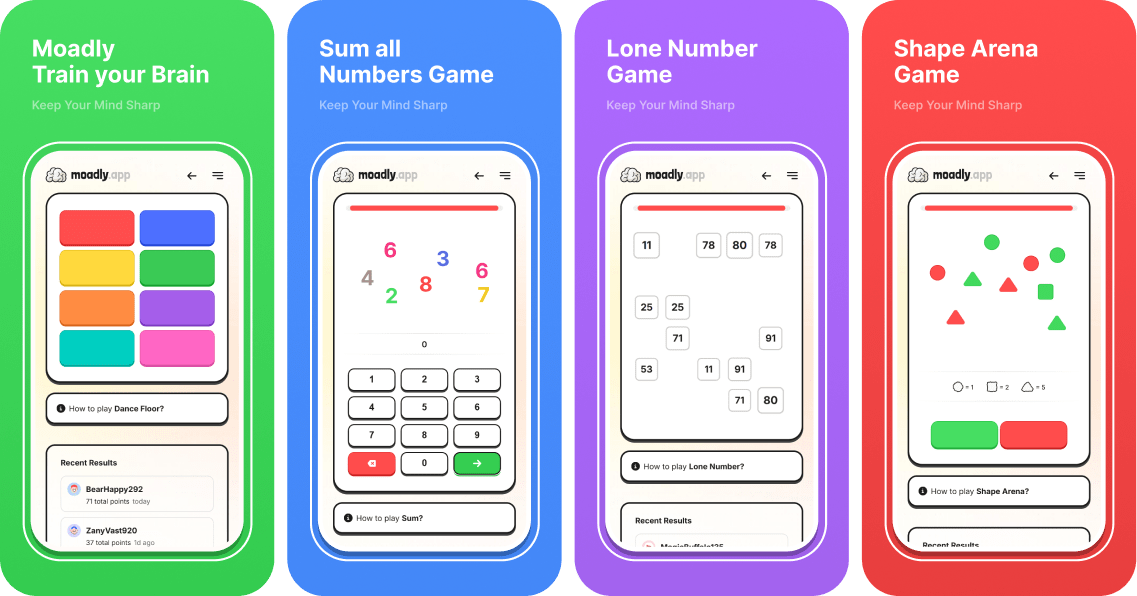
That means:
- No interstitial ads breaking sessions
- No artificial score inflation
- No endless novelty loops
- No puzzle-only training
Instead, sessions combine attention, working memory, and reasoning in ways that repeat core skills with adaptive difficulty.
The result is slower onboarding, but stronger long term outcomes.
The case study most apps avoid
Moadly publishes real user cognitive data at https://moadly.app/survey/.
The pattern is consistent:
- Attention improves first
- Memory follows after sustained repetition
- Consistency matters more than session length
These results do not come from flashy games. They come from boring, effective design choices.
Why people mistake stimulation for intelligence
Stimulation is loud. Intelligence growth is quiet.
Stimulation makes you feel busy. Intelligence growth makes you feel capable.
If a game constantly overwhelms you with colors, speed, and rewards, it is likely stimulating you, not training you.
This distinction explains why so many people bounce between apps while still struggling with focus, memory, and mental clarity.
Kids, adults, seniors all fall for this
This is not an age problem.
Kids get overstimulated. Adults get distracted. Seniors get frustrated.
Everyone loses when games prioritize feeling smart over being effective.
That is why targeted approaches, like those discussed in educational games for kids and brain games for seniors, matter so much.
How to spot a brain game that does nothing
Ask yourself:
- Do I feel sharper outside the app
- Does difficulty adapt to me or just get faster
- Can I measure progress beyond points
- Does the app protect my focus or constantly interrupt it
If the answers are mostly no, the game probably just feels smart.
So why do brain games that feel smart do nothing
Because they:
- Train surface skills instead of core cognition
- Rely on novelty instead of repetition
- Interrupt focus with ads
- Inflate progress artificially
- Optimize for engagement, not improvement
Your brain deserves better than clever illusions.
If you want entertainment, puzzles are great. If you want real cognitive change, look for systems that respect focus, value repetition, and accept that progress is quiet.
Feeling smart is easy to sell. Getting smarter takes patience.
Choose accordingly.