How does exercise improve memory and retention
.png)
Yes, exercise improves memory. Not in a motivational poster way. In a measurable, biological, brain chemistry way.
If you have ever noticed that ideas flow better after a walk. That you remember things more clearly after moving your body. Or that your brain feels sharper on days you are active. That is not coincidence. That is physiology doing its job.
I am going to explain this like a real human who exercises inconsistently, hates gyms some days, loves movement other days, and still benefits massively from it. No fitness influencer talk. No fake discipline stories. Just how movement actually upgrades memory and retention.
And yes. We will connect this to brain training, attention, and tools like moadly.app, because exercise and cognitive training work best together.
Memory is not just in your head
This is the first thing most people misunderstand.
Memory depends on:
- Blood flow
- Oxygen delivery
- Neurotransmitters
- Stress hormones
- Sleep quality
All of those are directly affected by physical activity.
When you exercise, your brain does not just sit there watching. It changes state.
What actually happens in your brain when you move
Let us get specific, without turning this into a textbook.
1. Increased blood flow equals better encoding
Exercise increases cerebral blood flow. That means more oxygen and glucose reach the hippocampus. That is the part of your brain heavily involved in memory formation.
Better fuel equals better encoding.
That is why learning something after light to moderate exercise sticks better. Your brain is literally more receptive.
This is one reason short movement breaks pair so well with mental training. A 10 minute walk followed by focused brain games is powerful.
You can see how this idea ties into attention training in this article.
2. Exercise increases BDNF, your brain fertilizer
BDNF stands for brain derived neurotrophic factor. Think of it as fertilizer for neurons.
BDNF:
- Helps neurons grow
- Strengthens connections
- Supports long term memory
Exercise is one of the most reliable ways to increase BDNF naturally.
More BDNF means your brain beco es better at learning and retaining information. Especially when you challenge it afterward.
This is where exercise plus cognitive games becomes more than the sum of its parts.
3. Stress hormones stop blocking your memory
Chronic stress floods your system with cortisol. Cortisol is terrible for memory.
High cortisol:
- Impairs recall
- Reduces focus
- Messes with sleep
Exercise lowers baseline stress levels. Not instantly, but consistently.
That is why people who move regularly often say their brain feels quieter. Less noise means better retention.
If stress and fog are constant for you, this guide explains how physical and mental strategies overlap.
4. Movement improves sleep, and sleep locks in memory
This part is huge and often ignored.
Memory consolidation happens during sleep. Especially deep and REM sleep.
Exercise improves:
- Sleep onset
- Sleep depth
- Sleep consistency
No supplement comes close.
Better sleep equals stronger memory retention the next day.
Exercise types and how they affect memory
Not all movement works the same way. You do not need to train like an athlete.
| Exercise Type | Memory Impact |
|---|---|
| Walking | Improves attention and recall, great for consistency |
| Cardio | Boosts BDNF and learning speed |
| Strength training | Supports long term brain health and focus |
| Coordination based | Improves working memory and adaptability |
Coordination heavy movement is especially interesting. Dancing, sports, or anything that requires timing and decision making directly trains memory circuits.
This is the same reason fast paced brain games work. They demand coordination inside your head.
There is a clear overlap described in how brain games stimulate neuroplasticity.
Exercise improves retention, not just learning
Learning something once is easy. Retaining it is the hard part.
Exercise helps retention by:
- Reducing mental fatigue
- Stabilizing mood
- Improving sleep cycles
- Strengthening neural connections
That is why people who exercise regularly often say they remember things longer, not just faster.
Brain fog, movement, and memory
If your memory issues feel like fog, exercise is often a missing piece.
Brain fog is not always about memory failure. It is about signal quality.
Movement improves that signal.
Several practical explanations live in:
- How to clear brain fog in 5 minutes
- What am I lacking if I have brain fog
- The impact of screen time on focus
Exercise counters almost every modern cause of fog.
Exercise alone is good. Exercise plus mental challenge is better
This is where things get interesting.
Exercise primes your brain. Mental challenge sculpts it.
Doing one without the other works. Doing both accelerates progress.
Think of it like this:
- Exercise opens the door
- Brain training walks through it
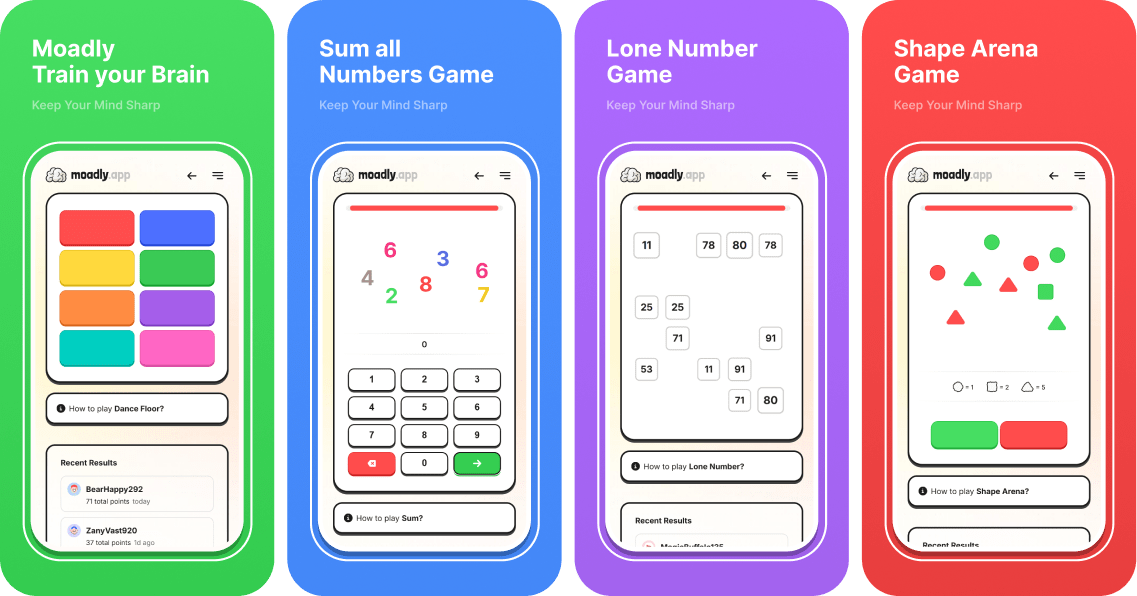
This is why pairing movement with tools like moadly.app is effective. Short, intense cognitive sessions after movement take advantage of heightened plasticity.
Games that involve memory, logic, speed, and combinations reinforce what exercise enables.
If you want examples of this style, fast paced brain training games explains the mechanism well.
Does this work for all ages?
Yes. And sometimes more dramatically for older adults.
Kids show improved learning and retention when physical play is paired with learning. See this guide.
Adults benefit through stress reduction and attention control.
Seniors often experience noticeable memory improvements from regular walking combined with cognitive games. This article explains why.
How much exercise is enough for memory?
You do not need extremes.
Effective minimum:
- 20 to 30 minutes of movement most days
- Light to moderate intensity
- Consistency over intensity
Even shorter bouts help if they are regular.
A walk plus 10 minutes of focused brain training beats an intense workout once a week.
What about people who hate exercise?
You do not have to love exercise. You just have to move.
Movement counts if it:
- Raises your heart rate slightly
- Requires coordination
- Breaks long sitting periods
There is no moral value attached. It is biology.
Common mistakes people make
- Waiting for motivation instead of building routine
- Going too hard and quitting
- Separating physical and mental health
- Expecting instant results
Memory improvement compounds quietly.
So, how does exercise improve memory and retention?
In simple terms:
- It feeds your brain better
- It reduces what blocks memory
- It strengthens neural connections
- It improves sleep and focus
Exercise prepares your brain to remember. Mental challenge teaches it what to keep.
If you want your memory to feel sharper, more reliable, and less foggy. Move your body. Then challenge your mind.
That combination works at any age, in any schedule, without hacks.
Your brain is built to move. When it does, memory follows.