Why your brain improves when apps do less
Most people searching for ways to improve memory expect complexity. More features. More levels. More flashing rewards. More pressure to perform. The strange truth is that memory usually improves faster when things get simpler, calmer, and more repetitive.
I am saying this as someone who grew up online, tried every productivity trick, downloaded way too many brain apps, and spent years wondering why nothing really stuck. At some point it clicked. My brain did not need to be entertained. It needed space, structure, and consistency.
That idea is at the core of how moadly.app approaches memory training. Fewer distractions. Clear rules. No fake dopamine loops. Just mental work that actually compounds over time.
If you have ever felt that memory improvement feels boring at first, you are not broken. There is even a whole breakdown of this feeling here: why memory improvement feels boring at first. Boring is often the sign that your brain is doing real work instead of chasing novelty.
What memory actually is and why most advice misses the point
Memory is not a single skill. It is not one muscle you train and suddenly everything gets sharper. It is a system made of attention, encoding, storage, and retrieval.
Most apps focus on the wrong layer. They obsess over difficulty, speed, or randomness. That is why so many so called smart games feel impressive but change nothing long term. There is a good explanation of this problem in brain games that feel smart but do nothing.
Real memory improvement usually comes from a few unsexy principles.
- Repetition that is spaced and intentional
- Focus without constant interruptions
- Progress tracking that shows trends, not just scores
- Low friction so you actually come back tomorrow
This is also why random challenges rarely help. Randomness feels fun, but it does not build stable neural patterns. That topic is explained deeply in why random challenges do not build real memory.
The myth that harder is always better
A lot of people assume that if a task feels hard, it must be good for the brain. That belief causes more burnout than progress.
Hard tasks can help. But only when they are matched to your current ability and repeated enough to matter. Constantly increasing difficulty can actually prevent consolidation. There is a full breakdown of this misconception in why harder games are not always better for your brain.
Think of memory like learning a language. You do not memorize one thousand new words a day. You repeat common patterns until they become automatic.
That is why repetition matters more than novelty. If you want the science side explained in plain language, why repetition matters more than novelty connects the dots really well.
Why most brain training apps fail long term
Many apps fail for the same reason diets fail. They rely on motivation instead of systems.
At first everything feels exciting. New games. New badges. New promises. Then real life hits. You skip a day. Then two. Suddenly the app feels annoying instead of helpful.
This is not a personal failure. It is a design problem. It is discussed honestly in why most brain training apps fail long term.
Here is a simple comparison.
| Overdesigned Apps | Simpler Systems |
|---|---|
| Daily streak pressure | Flexible consistency |
| Constant novelty | Structured repetition |
| Scores without context | Progress over time |
| Heavy gamification | Calm mental effort |
Moadly was built around the second column. That choice is intentional, even if it feels less flashy at first glance.
The attention economy is not helping your memory
We live inside an attention economy that constantly fragments focus. Every notification, feed, and animation competes for your working memory.
This matters because attention is the gatekeeper of memory. If attention is weak, nothing sticks. There is a strong argument about this in the attention economy is breaking focus tools.
Apps that truly help memory tend to do less. Fewer colors. Fewer sounds. Fewer reasons to multitask. This is not laziness. It is cognitive respect.
Gamification has a hidden downside
Gamification is not evil. But it is often misused.
When rewards replace reflection, learning becomes shallow. You chase points instead of understanding patterns. Over time, motivation collapses because the rewards stop feeling meaningful.
This is explored in detail in the hidden downside of gamified learning.
Moadly uses light structure instead of heavy gamification. No spinning wheels. No loot boxes. Just feedback that shows how your memory actually changes.
.png)
Can you really improve your memory
Yes. But not instantly.
The promise of instant cognitive improvement is one of the biggest myths in this space. Real change happens gradually. Sometimes quietly. Often without dramatic moments.
If you want a grounded answer, is it possible to improve your memory lays it out without hype.
Memory improvement usually looks like this.
- Better recall under pressure
- Less mental fatigue during the day
- Faster pattern recognition
- Improved focus when reading or listening
Not superpowers. Just a brain that works more smoothly.
Daily habits that matter more than any app
No app can fix a lifestyle that constantly drains your brain. The basics still matter.
- Sleep. Memory consolidates during rest.
- Movement. Exercise directly supports memory formation. Explained here: how exercise improves memory and retention.
- Nutrition. Supplements are secondary. If curious, see what is the best supplement to improve memory.
- Reduced cognitive noise. Less doom scrolling, more intentional thinking.
Apps work best when they support these habits instead of replacing them.
Why moadly.app feels different
Moadly does not promise miracles. It does not pretend puzzles alone make you smarter. In fact, that idea is directly challenged in why puzzles alone do not improve intelligence.
What it does offer is a realistic system.
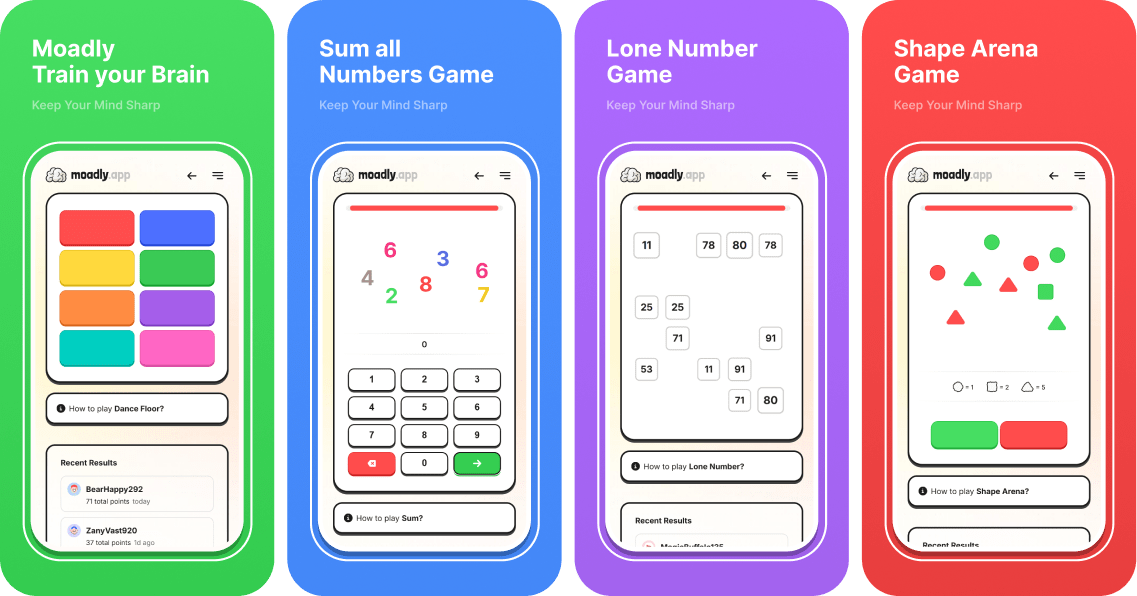
- Memory focused exercises
- Clear progress tracking
- No subscriptions pressure
- Exercises designed to be repeatable
If you want an overview of how it fits into daily life, apps for daily mental workouts without losing motivation is worth reading.
Consistency beats intensity every time
Five minutes a day done consistently beats one intense session once a week. This applies to memory, focus, and learning.
That is why the easiest app to stick with often wins long term. There is a reason easiest brain training app to stick with every day exists as a topic.
Your brain does not want to be impressed. It wants predictability and gentle challenge.
Seeing progress without obsession
One underrated feature of good memory training is perspective. Seeing improvement over weeks and months helps motivation without creating anxiety.
This idea is explored in best free brain app for seeing how your skills improve over time.
Moadly focuses on trends, not daily perfection. Miss a day. It is fine. Come back tomorrow.
When your brain feels tired or foggy
Not all mental fatigue is the same. Brain fog and mental fatigue often get confused, but they feel different and require different approaches.
If you struggle to tell the difference, how mental fatigue differs from brain fog explains it clearly.
Memory training should never feel punishing. If it does, something is off.
Final thoughts that actually matter
The best ways to improve memory are not flashy. They are calm. Repetitive. Slightly uncomfortable at first.
Apps help when they respect how the brain really works. They hurt when they try to hijack motivation instead of supporting learning.
If you want a realistic place to start, explore best app for practicing memory focus and mental agility, then actually give it time.
Your brain improves when apps do less because your brain finally gets to do the work.