Why memory improvement feels boring at first
Memory improvement rarely fails because it does not work. It fails because it does not feel like anything is happening. No rush, no spark, no obvious moment where you think wow, this is changing my brain.
Early memory training feels flat, repetitive, and honestly a bit dull. That feeling pushes people away long before results appear. The uncomfortable truth is that boredom is often the first real sign that memory improvement is actually working.
We live in a world where stimulation equals value. If something feels exciting, we assume it is effective. If it feels boring, we assume it is broken. Memory improvement breaks that rule completely. The mechanisms that strengthen recall, retention, and stability are the same ones that remove novelty, reduce noise, and slow things down. That combination feels wrong at first, especially if you are used to apps that constantly push new content, new mechanics, and new rewards.
Why your brain does not reward memory work instantly
Memory formation is not designed to feel rewarding in real time. It evolved to prioritize survival, not entertainment. When the brain decides something matters, it strengthens connections quietly and gradually. There is no built in dopamine spike for correct recall repetitions, especially when the task itself is simple.
Most modern apps condition users to expect instant feedback. Scores go up, streaks flash, animations celebrate tiny actions. Memory improvement does not do that naturally. When apps try to force excitement into memory tasks, they usually succeed in making them feel fun while quietly sabotaging retention.
The boredom paradox
Boredom during memory training feels like wasted time, but biologically it signals stability. Stable conditions are exactly what memory needs to consolidate. When stimulation drops, the brain stops scanning for novelty and starts reinforcing existing pathways.
This is the paradox. The more entertaining a memory task feels, the less effective it often is. The more boring it feels, the more likely it is that the brain is actually doing consolidation work instead of performance work.
What boredom actually means in memory training
- Low novelty, which allows repeated signals to strengthen the same neural pathways
- Reduced distraction, which improves encoding quality
- Predictable structure, which helps the brain decide the task matters
- Lower emotional arousal, which supports long term retention
None of these feel exciting. All of them are essential.
Why puzzle based memory apps hide the problem
Many brain apps disguise memory tasks inside puzzles, stories, or competitive mechanics. This makes sessions feel engaging, but it splits attention. The brain focuses on winning, progressing, or reacting quickly instead of storing information reliably.
This is why people often feel smarter without actually remembering more in daily life. The app trained task performance, not memory capacity. This pattern shows up repeatedly in discussions like brain games that feel smart but do nothing.
Repetition is boring for a reason
Repetition feels pointless because the brain stops noticing it consciously. That is exactly why it works. Each repetition strengthens the same pathway without requiring attention to novelty. When you constantly change tasks, the brain stays in learning mode instead of consolidation mode.
This is why repetition matters more than novelty for memory improvement, even though novelty feels more motivating in the short term.
What happens during the boring phase
| What you feel | What the brain is doing |
|---|---|
| Bored, unstimulated | Reducing cognitive noise |
| No obvious progress | Strengthening baseline recall stability |
| Repetition feels pointless | Reinforcing existing memory pathways |
| Lack of excitement | Shifting from performance to consolidation |
This phase is invisible by design. The brain prioritizes durability over sensation.
.png)
Why increasing difficulty does not fix boredom
When boredom appears, most apps respond by making tasks harder. Faster timers, more items, more pressure. This creates intensity, not better memory. Stress interferes with encoding and retrieval, even if performance temporarily improves.
This is why harder games are not always better for your brain. Difficulty without stability creates fragile memory that collapses under distraction.
Consistency beats excitement every time
Memory improves through consistent exposure, not heroic effort. Five to ten minutes daily creates stronger results than long, irregular sessions. Consistency tells the brain that the information or skill is worth keeping.
- Short sessions reduce fatigue
- Daily repetition improves retention
- Predictable structure reduces cognitive load
This is why resources like daily brain games to wake up your mind emphasize routine over motivation.
Why adults struggle more with the boring phase
Adults are conditioned to expect efficiency. If effort does not show immediate returns, it feels wasteful. Children tolerate repetition better because they are not measuring progress constantly.
This is why adults search for shortcuts like how to get a fast cognitive boost every day. Unfortunately, fast boosts fade quickly. Memory improvement is about raising the baseline, not chasing peaks.
Memory improvement changes how things fail
One reason progress feels invisible is that improvement often shows up as fewer failures, not more successes. You forget less often. You recover faster when distracted. You lose your train of thought less frequently.
These changes are subtle and easy to miss. They do not announce themselves with excitement.
How moadly approaches boredom differently
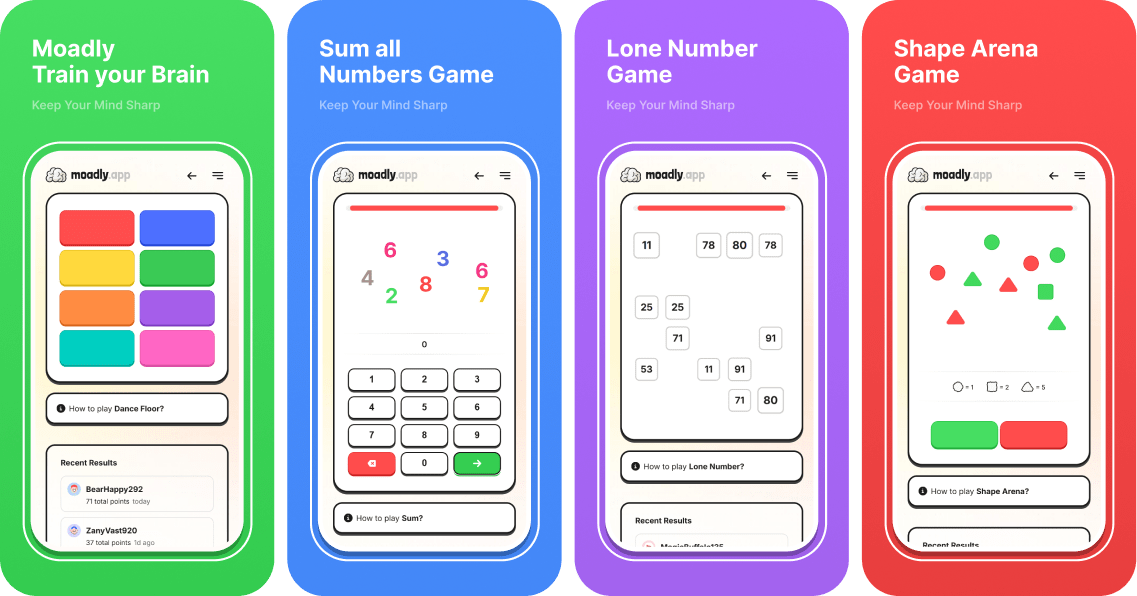
Moadly does not try to mask boredom with noise. It embraces the conditions required for memory adaptation. Sessions are short, focused, and repetitive by design. There are no interstitial ads interrupting focus, no artificial urgency, and no pressure to constantly escalate difficulty.
This approach aligns with patterns seen in the data shared at https://moadly.app/survey/, where users report gradual improvements in recall stability and focus rather than sudden jumps.
When boredom fades
Boredom does not last forever if consistency remains. As tasks require less effort, mental space opens up. Sessions start feeling calm instead of dull. Focus becomes easier to sustain. This shift often happens quietly, without a dramatic moment.
People who quit early never experience this phase.
Boredom versus burnout
| Boredom | Burnout |
|---|---|
| Flat, neutral feeling | Strong resistance or anxiety |
| Manageable effort | Mental exhaustion |
| Supports consolidation | Blocks learning |
Understanding this difference prevents unnecessary quitting and overtraining.
The cultural bias against boring progress
We celebrate breakthroughs, hacks, and shortcuts. We rarely celebrate slow improvement. This bias shapes how tools are built and how users judge themselves. Memory improvement does not fit this narrative, which is why it feels wrong before it feels right.
The honest truth
Memory improvement feels boring at first because it is real. It removes stimulation, novelty, and urgency. What remains is repetition, consistency, and time. If something feels exciting immediately, it is probably entertaining you, not changing you.
Boredom is not a failure signal. It is an adaptation signal. Stay long enough, and the boring phase becomes the foundation for memory that actually lasts.