Why repetition matters more than novelty
Novelty feels good. New games, new mechanics, new visuals, new promises. Your brain lights up for a moment and you feel engaged. That short spark is exactly why so many brain apps obsess over novelty. But here is the uncomfortable truth. Novelty alone does not build a better brain. Repetition does.
If you have ever jumped between brain apps, games, routines, or productivity systems, always chasing something fresh, you already felt this problem without naming it. You stayed entertained. You did not stay sharper.
This is about why repetition, done correctly, beats novelty every single time when it comes to memory, focus, and intelligence. It is also about why most apps fail long term by constantly reinventing themselves instead of letting your brain actually adapt.
The brain does not grow from surprise. It grows from reinforcement
Novelty triggers dopamine. That is the feel-good chemical. It tells your brain, “Pay attention, something new is happening.” This is useful for exploration, not for mastery.
Repetition is what strengthens neural pathways. Each time you repeat a task, your brain:
- Fires the same neural circuits
- Reduces energy cost for that activity
- Improves speed, accuracy, and confidence
This process is how skills become automatic. Reading. Driving. Speaking. Remembering names. None of these came from novelty. They came from repetition layered with small variations.
This is why articles like how brain games stimulate neuroplasticity and focus emphasize consistent practice over flashy mechanics.
Why novelty feels productive but usually is not
Novelty gives the illusion of progress.
You download a new app. You try a new brain game. You explore new rules. You feel mentally active. But activity is not the same as improvement.
Here is what novelty-heavy systems usually cause:
- Surface-level engagement without depth
- No stable baseline to measure improvement
- Constant relearning instead of strengthening
Your brain never gets enough repetitions to lock anything in. You are always onboarding, never training.
This is one reason people searching for how to stop being so forgetful feel stuck. They are stimulating their brain, not reinforcing it.
Repetition is how memory actually forms
Memory is not stored instantly. It is consolidated over time.
Each repetition strengthens the signal. Skip repetition and the memory fades. This applies to:
- Working memory
- Long-term recall
- Attention control
- Problem-solving strategies
This is why cramming feels intense but fails long term. Your brain needs spaced repetition, not constant novelty.
Daily exposure, like in daily brain games to wake up your mind, outperforms occasional novelty bursts every time.
Why most brain apps overvalue novelty
Because novelty sells.
App stores reward screenshots and first impressions. Ads reward excitement. Repetition looks boring in a trailer.
So apps:
- Introduce new games constantly
- Rotate mechanics before mastery happens
- Replace depth with variety
The result is a system optimized for downloads, not for brains.
That is why many users bounce between “best brain apps” lists like this one without seeing meaningful change.
Repetition does not mean boredom
This is the part people misunderstand.
Repetition is not doing the exact same thing forever. It is revisiting the same core skills under slightly changing conditions.
Good repetition includes:
- Stable mechanics
- Adaptive difficulty
- Small variations that force attention
This keeps your brain engaged while still reinforcing the same neural pathways.
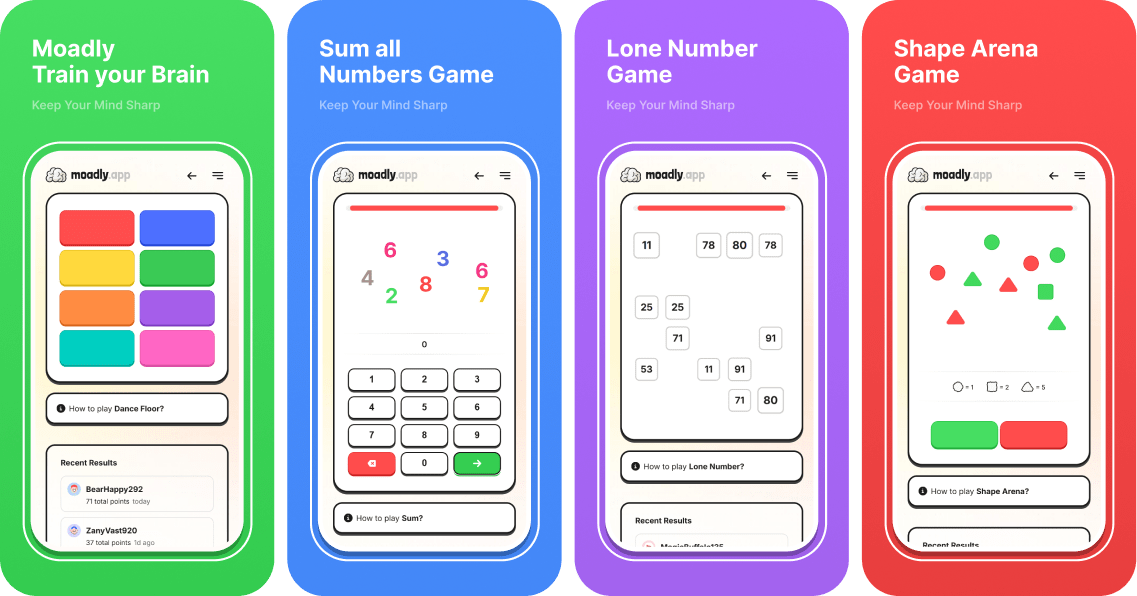
Moadly uses this approach intentionally. The core cognitive skills stay consistent. Attention, memory, logic. The surface details change just enough to prevent autopilot.
Why repetition matters more as you age
As we get older, novelty becomes less efficient as a learning tool. The brain still adapts, but it needs clearer signals and more reinforcement.
This is why seniors benefit more from consistent cognitive routines than from constantly new games. It is also why brain games for seniors that focus on repetition outperform flashy alternatives.
Repetition reduces cognitive load. It allows energy to be spent on improvement instead of orientation.
Repetition builds confidence, novelty builds anxiety
Constant novelty keeps your brain in evaluation mode. What are the rules. What is expected. Am I doing this right.
Repetition creates familiarity. Familiarity reduces stress. Reduced stress improves learning and memory.
This is especially important for people dealing with burnout or fog. For them, novelty can feel overwhelming, not stimulating.
That is why content around attention training in brain fog recovery emphasizes consistency over excitement.
Repetition enables measurement
You cannot measure progress if the task changes constantly.
Repetition creates a stable baseline. This allows you to see:
- Faster response times
- Improved accuracy
- Better sustained attention
Without repetition, every session is a reset. You feel busy, not better.
This is one of the reasons moadly publishes real user data at https://moadly.app/survey/. Repetition allows trends to emerge. Novelty hides them.
Why repetition transfers to real life
Real life is repetitive.
You focus at work. You remember tasks. You follow conversations. You solve problems. These skills repeat daily.
Training them repeatedly is what creates transfer. Not solving a new type of puzzle every session.
This is why people looking for a fast cognitive boost every day benefit more from consistent routines than from chasing the next big brain game.
What happens when novelty dominates
When novelty dominates training, users often experience:
- Initial excitement
- Rapid drop-off
- No lasting cognitive change
This pattern shows up in almost every puzzle-heavy app. High downloads. Low retention. Minimal long-term impact.
It is not because users are lazy. It is because the system never allowed their brains to adapt.
How moadly balances repetition and novelty
Moadly does not eliminate novelty. It controls it.
The structure is repetitive by design. The surface experience evolves.
- Core skills stay consistent
- Difficulty adapts gradually
- Sessions remain short and focused
- No interstitial ads break flow
This keeps users engaged without resetting their progress every time.
It also explains why users report less mental fatigue and better focus after a few weeks instead of a few days.
Repetition beats intensity
A single intense session does less than many calm, repeated sessions.
Your brain prefers predictable effort over chaotic spikes. This is why five minutes a day can outperform an hour once a week.
This principle applies to memory, intelligence, and attention equally.
Why repetition feels slower but works faster
Repetition feels slow because change is subtle. But subtle change compounds.
One percent improvement daily feels invisible. Over a month, it is obvious. Over three months, it is transformative.
Novelty gives spikes. Repetition builds curves.
So why repetition matters more than novelty
Because repetition:
- Strengthens neural pathways
- Reduces cognitive load
- Improves transfer to real life
- Allows progress to be measured
- Builds sustainable habits
Novelty has its place. Exploration. Motivation. Discovery.
But if your goal is a sharper mind, better memory, and stronger focus, repetition is non-negotiable.
Your brain does not need constant surprise. It needs consistent signals.
Train it like you mean it, not like you are scrolling for stimulation.