Why most brain training apps fail long term
.png)
Let me be blunt for a second. Most brain training apps do not actually train your brain. They keep you busy, they give you a dopamine tickle, and then they slowly stop working. Not because your brain hit some magical ceiling, but because the apps themselves were never designed for long term cognitive change.
If you have ever downloaded a brain app, played it obsessively for a week, felt smart for a moment, and then quietly forgot it existed, you are not broken. The system is.
I am going to walk through why this keeps happening, what actually helps memory long term, and where platforms like moadly.app intentionally went in the opposite direction. No guru tone. No fake neuroscience. Just real patterns from real users.
Most apps have nothing to do with brain training. They are just puzzle games
This is the biggest lie in the category.
Most so called brain training apps are just reskinned puzzle games. Match three tiles. Tap the odd shape. Remember a pattern for five seconds. None of this is bad, but calling it brain training is like calling Sudoku a full gym workout.
Real cognitive training focuses on transfer. That means improvements that carry over into daily life. Better attention at work. Better recall in conversations. Less mental fatigue when reading or learning something new.
Puzzle-only apps fail here because:
- They train one narrow mechanic, not a cognitive skill
- Difficulty often increases artificially, not adaptively
- Your brain memorizes the trick instead of building capacity
That is why people feel a short boost and then hit a wall. You are not getting smarter. You are getting better at the app.
If you want examples of games that actually stimulate focus and neuroplasticity, compare this with how neuroplasticity-focused games are structured versus classic puzzles.

They are not complicated
This might sound counterintuitive. People assume simple is good. Simple is approachable. Simple is relaxing.
But the brain adapts incredibly fast.
If a task does not evolve in complexity, your brain stops allocating effort to it. That is not motivation. That is biology.
Most apps:
- Repeat the same mechanics with faster timers
- Add cosmetic difficulty instead of cognitive load
- Never challenge working memory and attention together
True cognitive strain feels slightly uncomfortable. Not frustrating, but effortful. It is the same reason why learning a new language works your brain more than scrolling trivia.
That is why many users searching for how to stop being so forgetful end up disappointed. The tools they use never progress with them.
Moadly takes a different approach. Difficulty adapts not just to performance, but to consistency. Miss days, the system compensates. Improve fast, the system pushes back harder.
This matters more than people think.
They are full of ads
This is where things quietly fall apart.
Ads are not just annoying. They actively break cognitive flow.
Memory formation relies on sustained attention. Every time an ad interrupts you, especially a rewarded or autoplay video, your brain context switches. You lose the thread.
Most free brain apps monetize like this:
| Ad type | Effect on cognition |
|---|---|
| Banner ads | Constant distraction, low level attention drain |
| Rewarded videos | Trains you to associate thinking with interruption |
| Interstitial ads | Complete flow destruction |
Which brings us to the worst offender.
Interstitial ads are annoying
Interstitial ads are not just annoying. They are destructive.
Imagine trying to build focus while someone taps you on the shoulder every 90 seconds. That is what interstitial ads do to your brain.
Users dealing with burnout or fog already struggle with attention. For them, this is brutal. It is one reason articles like how to stay focused during mental burnout keep ranking.
Brain training should feel like entering a mental gym. Interstitial ads feel like being kicked out mid set.
Moadly intentionally avoids this model. No popups mid session. No sudden hijacks of attention. If you cannot stay focused inside the app, the app has failed.
.png)
What actually improves memory long term
Now the useful part.
Long term memory improvement is boring to market but powerful in practice. It is not about hacks. It is about stacking small cognitive wins.
The things that actually work:
- Attention training. Memory starts with focus. If you cannot hold attention, nothing sticks. See why attention training matters for brain fog recovery.
- Working memory load. Holding and manipulating information at the same time.
- Progressive complexity. Tasks must evolve, not repeat.
- Consistency over intensity. Five minutes daily beats one hour once a week.
- Low distraction environments. Fewer notifications, fewer ads, fewer exits.
This is why daily micro sessions like those described in daily brain games to wake up your mind outperform binge sessions.
Why most people quit anyway
Even when apps are decent, people still quit. Here is why.
- No visible progress beyond scores
- No connection to real life improvements
- No sense of purpose
Seeing numbers go up is not enough. People want to feel sharper in conversations. Less foggy at work. Faster when learning something new.
This is why content around fixing brain fog and quick clarity resets resonates so strongly.
Shameless but honest. Why moadly.app is built differently
Yes, this is where I shill a bit. But transparently.
Moadly was built after watching people fail with traditional brain apps over and over. The goal was not to entertain endlessly. It was to create measurable cognitive momentum.
Key differences:
- No interstitial ads interrupting sessions
- Games that blend attention, memory, and logic together
- Adaptive difficulty based on consistency patterns
- Designed for adults, seniors, and burned out brains
If you look at how users describe their experience in what doctors think about brain training apps, the common thread is sustainability. Not hype.
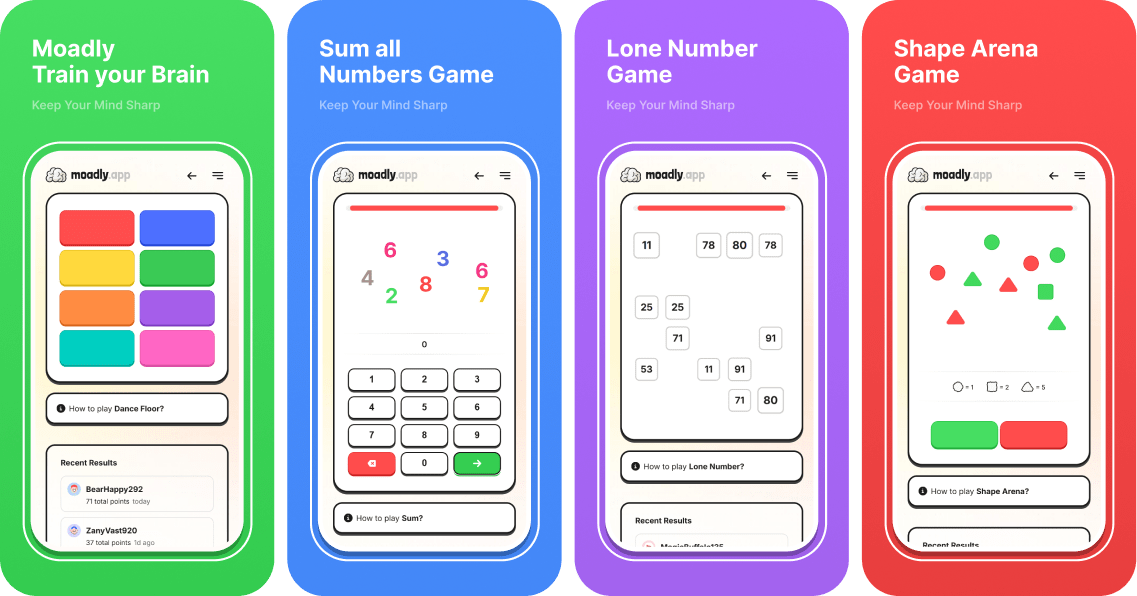
The case study. Real data, not vibes
This is the part most apps avoid.
Moadly openly publishes user cognitive surveys and longitudinal data at https://moadly.app/survey/.
What stands out:
- Users report reduced mental fatigue after 2 to 3 weeks
- Consistency correlates more strongly with improvement than session length
- Attention scores improve before memory recall
This matches cognitive science expectations. Attention comes first. Memory follows.
It also explains why people searching for what am I lacking if I have brain fog often misunderstand the root cause. It is not missing intelligence. It is fragmented attention.
Kids, adults, seniors. Different brains, same mistake
Brain apps often pretend one size fits all.
Kids need engagement and novelty. Adults need efficiency. Seniors need clarity and low friction.
That is why content like educational games for kids and brain games for seniors should not overlap as much as they do in app stores.
Moadly separates cognitive load profiles instead of forcing everyone into the same funnel.
So why do most brain training apps fail long term
Short answer:
- They entertain instead of train
- They interrupt instead of focus
- They sell hope instead of progress
Long term memory improvement is quiet. It feels subtle. Then one day you realize you are less foggy. You recall names faster. You finish tasks with less mental drag.
That is not sexy marketing. But it works.
If you are serious about your brain, treat it like a system, not a toy. And if an app makes you watch ads to think, maybe close it and give your attention back to something that respects it.
Your brain is already doing enough work. The tools you use should help, not hijack it.