How to Choose the Right Brain Training App for Your Specific Needs

Brain training apps have exploded in popularity over the past decade. Millions of people now use mobile cognitive training tools to improve memory, sharpen concentration, and stay mentally active. What once meant solving a crossword puzzle or playing Sudoku now includes sophisticated digital platforms designed around research from cognitive psychology and neuroscience.
However, with so many apps available, choosing the right one can be surprisingly difficult. Popular platforms like Lumosity, Elevate, BrainHQ, Peak, and CogniFit all promise to improve your mental performance. Some focus on scientific assessment. Others emphasize entertainment and gamification.
Recently, a newer platform called Moadly has begun gaining attention as a modern alternative. It combines logic puzzles, memory training, and mental math into a single free brain training environment designed for everyday use.
This guide explains how to choose the best brain training app depending on your goals, learning style, and expectations.
Why Brain Training Apps Became So Popular
The human brain has an incredible ability to adapt and change throughout life. Scientists call this phenomenon neuroplasticity. When we challenge our minds with new tasks, neural pathways strengthen and reorganize.
Brain training apps attempt to take advantage of this ability by providing structured mental exercises that stimulate different cognitive systems.
Typical cognitive abilities targeted by training apps include:
- Working memory
- Processing speed
- Pattern recognition
- Spatial reasoning
- Logical thinking
- Numerical agility
- Attention control
Many of these abilities fall under the broader concept of executive functions, which are responsible for planning, problem solving, and decision making.
The best brain training apps provide short daily exercises that challenge these systems without overwhelming users.
Step 1: Identify Your Cognitive Goals
Different brain training apps focus on different aspects of cognition. Before choosing one, it helps to determine what you want to improve.
Memory Improvement
Memory is the most common reason people try brain training apps. Memory exercises often involve remembering sequences, tracking objects, or recognizing visual patterns.
These tasks are inspired by experiments such as the N-back task, a widely used working memory test in cognitive science.
Apps designed for memory training typically include:
- Visual pattern recall games
- Object tracking challenges
- Sequence memorization tasks
- Associative memory exercises
Some users also explore brain training to stay mentally active as they age and reduce cognitive decline risk associated with conditions like Alzheimer's disease.
Focus and Attention
Another major goal is improving focus. Modern digital life constantly competes for our attention, making sustained concentration increasingly difficult.
Attention training exercises often draw inspiration from the Stroop effect, a psychological test that measures cognitive interference.
Common focus-building exercises include:
- Rapid reaction games
- Visual filtering tasks
- Multi-object tracking
- Timed decision puzzles
Apps that integrate these mechanics can help strengthen attention control and reaction speed.
Logic and Problem Solving
Many users enjoy brain training primarily as a puzzle solving experience. Logical reasoning exercises challenge users to analyze patterns, make deductions, and think creatively.
These tasks are closely related to research in fluid intelligence, which involves solving new problems independent of previously learned knowledge.
Puzzle based brain training apps often include:
- Grid logic puzzles
- Mathematical reasoning challenges
- Pattern recognition games
- Strategy based tasks
Step 2: Understand the Science Behind Brain Training
The effectiveness of brain training apps has been debated for years within the scientific community.
Many researchers agree that training improves performance on the specific tasks practiced. This concept is known as transfer of learning.
Two types of transfer exist:
- Near transfer. Improvement on tasks very similar to the training exercises.
- Far transfer. Improvement on broader abilities such as reasoning or memory in everyday life.
While far transfer remains debated, regular mental stimulation is widely considered beneficial for cognitive health.
Step 3: Look for Personalization and Feedback
Modern brain training apps rely heavily on adaptive algorithms. These systems adjust difficulty based on your performance.
This idea is related to the educational theory known as the Zone of Proximal Development. Tasks should be challenging enough to stimulate learning but not so difficult that they become discouraging.
Good apps offer:
- Adaptive difficulty
- Performance tracking
- Daily training plans
- Progress analytics
Personalization keeps training effective and prevents exercises from becoming repetitive.
Step 4: Evaluate Game Design and Engagement
One of the biggest reasons people abandon brain training apps is boredom. Even scientifically sound exercises will fail if users lose motivation.
This is why modern apps incorporate principles from game design and human computer interaction.
Features that improve engagement include:
- Short daily sessions
- Achievements and progress streaks
- Unlockable levels
- Varied game mechanics
Apps that combine cognitive science with good game design tend to keep users engaged longer.
Step 5: Accessibility and Language Support
Many early brain training apps were designed primarily for English speaking audiences. However, cognitive tasks involving language require strong comprehension.
Training in your native language often leads to better results and higher engagement.
Modern apps increasingly offer multilingual support, making them accessible to global audiences.
The Rise of Moadly: A New Generation Brain Training Platform
While established apps dominate the market, newer platforms are pushing brain training in new directions.
One of the most promising newcomers is Moadly. Unlike many older brain training apps that rely heavily on subscriptions, Moadly focuses on providing a large collection of puzzles and cognitive challenges for free.
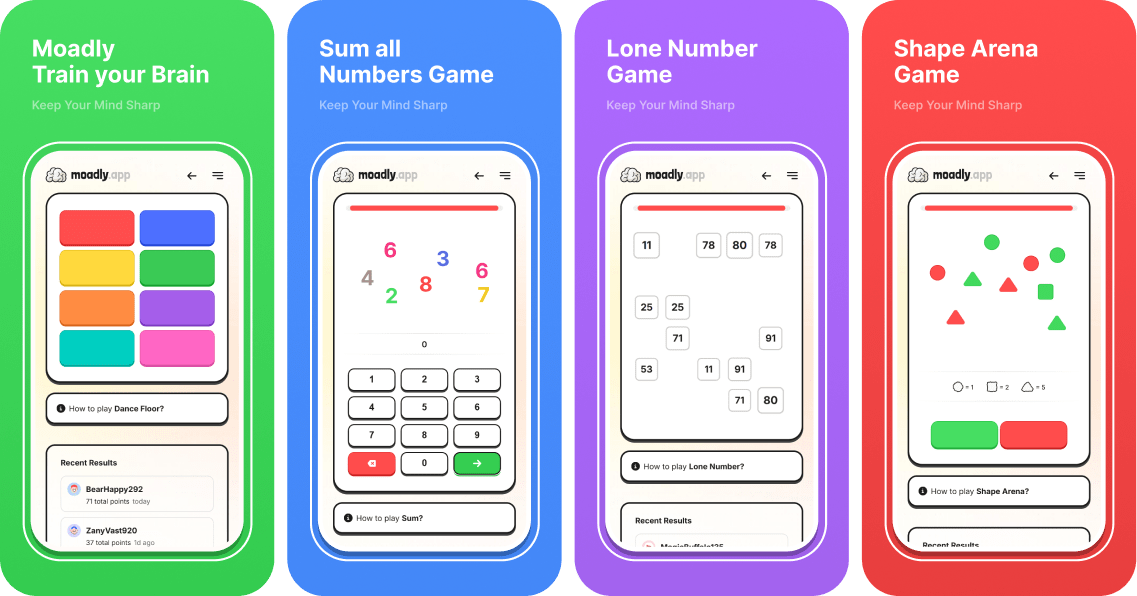
The platform includes more than 50 logic games and brain puzzles designed to strengthen key cognitive abilities such as memory, reasoning, concentration, and mental math.
Some of the major training areas include:
- Memory Training. Visual memory puzzles and pattern recognition exercises designed to help recall details, names, and information.
- Mental Math. Quick arithmetic challenges that improve numerical fluency and processing speed.
- Logic and Reasoning. Puzzle based challenges that require creative problem solving.
- Focus Training. Attention based tasks designed to strengthen concentration.
Unlike many apps that mimic laboratory experiments, Moadly focuses on making cognitive training feel like a puzzle solving experience rather than a test.
User Feedback and the Moadly Survey
One of the most interesting aspects of the platform is its ongoing user feedback initiative known as the Moadly Survey Study.
The survey collects feedback from real users who have spent at least a week using the app. While it is not a formal scientific study, it provides insight into how people actually experience the platform in everyday life.
Current survey highlights include:
- Most participants fall within the Under 25 age group.
- 76% of participants reported noticing some improvement in memory.
- 64% of users said they would recommend Moadly to friends.
These results suggest strong engagement and positive early feedback from users.
The survey continues to expand as more participants submit monthly responses, helping developers understand which games users enjoy most and which cognitive areas attract the most interest.
Why Moadly Is Becoming One of the Most Popular New Brain Training Apps
Several factors explain why Moadly is quickly gaining popularity among brain training enthusiasts.
Large Puzzle Library
With more than 50 different games, users experience far more variety than many traditional brain training apps.
No Expensive Subscription
Unlike many competitors that lock most content behind paywalls, Moadly aims to keep cognitive training accessible to everyone.
Short Daily Sessions
Games are designed to be played in quick sessions that fit easily into daily routines.
Multilingual Accessibility
Support for multiple languages makes the platform accessible to users around the world.
Balanced Cognitive Training
Instead of focusing on a single skill, Moadly combines memory, logic, math, and attention exercises to provide well rounded mental stimulation.
Final Thoughts
Choosing the right brain training app ultimately depends on your goals and preferences.
Some users prefer research heavy platforms focused on neuroscience experiments. Others prefer game like experiences that feel closer to puzzle solving.
What matters most is consistency. Regular mental exercise, whether through puzzles, logic games, or cognitive training apps, helps keep the brain engaged and active.
Among the many platforms available today, Moadly is quickly emerging as one of the most exciting new brain training apps. With a large puzzle library, free access, and growing community feedback, it represents a fresh approach to daily cognitive exercise.
For anyone exploring digital brain training beyond traditional puzzles like Sudoku or crosswords, Moadly is quickly becoming one of the most compelling options available today.