How to train brain with arithmetic

Short version: arithmetic is one of the cleanest, most portable ways to train attention, working memory, processing speed, and mental flexibility. It asks your brain to do real-time juggling with numbers, rules, and strategies, and that juggling strengthens the circuits you use for thinking clearly in everyday life.
Why arithmetic works
- Working memory practice. Keeping numbers and partial results in your head forces your working memory to stretch, which helps with tasks like following conversations and remembering steps.
- Attention and focus. Solving problems requires sustained attention, even if the problem is a 30-second mental sprint. That practice directly improves focus.
- Processing speed. Timed arithmetic trains the brain to make accurate calculations faster, and faster mental processing makes everything else feel smoother.
- Problem structuring. Breaking a problem into steps is the same skill you use when planning, debugging, or learning new tools.
How this connects to neuroplasticity and focus
Arithmetic is a simple lever for neuroplasticity. When you repeat targeted, slightly-challenging numeric tasks, the brain adapts. Over time, those adaptations make cognitive tasks less effortful. If you want to explore more games and exercises that build the same effect, check out how brain games stimulate neuroplasticity and focus and daily brain games to wake up your mind.
Daily arithmetic routine (easy to follow)
- Warm up, 3 minutes. Simple additions and subtractions, single-digit, no timer. Think of this like stretching your brain.
- Core workout, 10–20 minutes. Timed drills: two-digit plus two-digit, mental multiplication tables, and number sequences. Use short sets with breaks in between.
- Challenge set, 5–10 minutes. Multi-step problems that involve holding partial results, or quick mental estimation challenges.
- Cool down, 3 minutes. Slow, deliberate problems. Check accuracy and notice the feel of solving calmly.
Tip: consistency beats intensity. Ten minutes most days is better than one hour once a week. For structured daily drills, see daily brain games to wake up your mind and fast-paced brain training game that keeps your mind active.
Exercises you can do anywhere
- Mental multiplication ladder. Start with 6 x 7, then 12 x 7, then 12 x 14, then 24 x 14. Increase the number of steps.
- Backward subtraction. Start at 1000, subtract 37, then 29, then 86. Keep the running total in your head.
- Split-and-add. Break 89 + 76 into 80 + 70 and 9 + 6, then recombine. Practice different split strategies and time yourself.
- Estimation sprints. Look at a price list or a receipt and estimate the total without writing anything down.
- Number chaining. Pick a number, add 7, multiply by 3, subtract 5, divide by 2. Track the result mentally for several steps.
Games that scale and keep you motivated
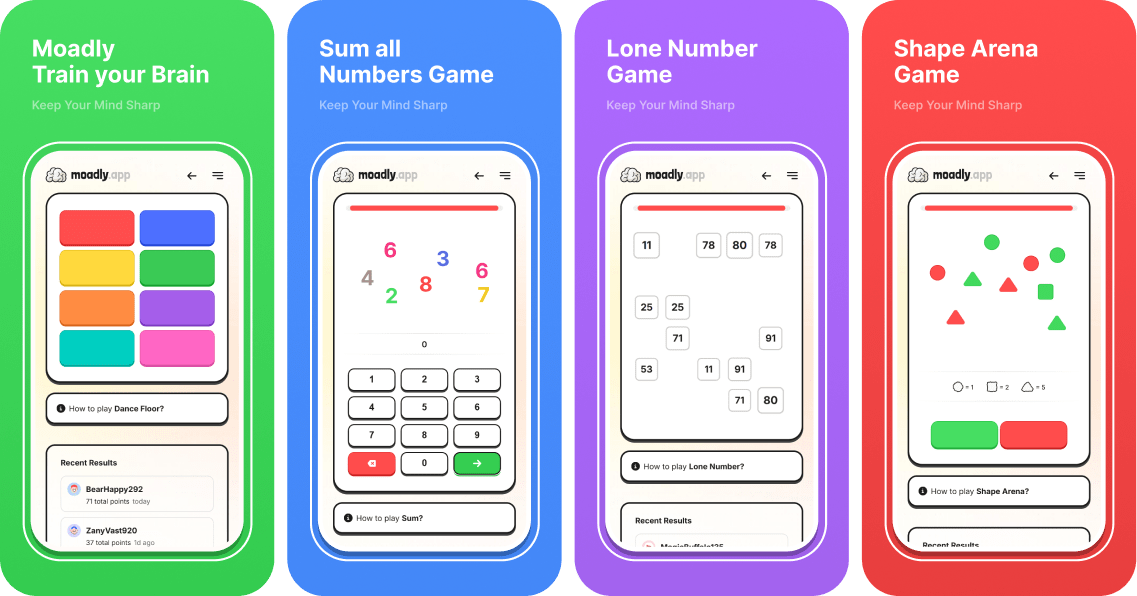
Games are essential. They add stakes, variety, and the dopamine that helps learning stick. For a practical list of games and apps, check best websites and apps to help keep your brain sharp and focused. Moadly’s collection has lots of arithmetic-based challenges and paced drills, like the fast-paced math rounds described in fast-paced brain training games to boost focus.
| Exercise | Duration | Main Benefit |
|---|---|---|
| Timed addition drills | 5–10 min | Processing speed |
| Mental multiplication ladder | 5 min | Working memory |
| Number chaining | 5–15 min | Complex sequencing |
| Estimation sprints | 2–5 min | Everyday numeracy |
How to structure practice for real gains
- Progressive overload. Make the tasks slightly harder every few days. If two-digit addition is easy, move to quick mental multiplication, then timed multi-step problems.
- Mix difficulty. Follow a hard set with an easy one. That contrast helps attention reset and keeps motivation high.
- Track results. Keep a simple log: date, exercise, time, accuracy. Small visible improvements are motivating.
- Rest and sleep. Memory consolidation happens during sleep. Training without rest is wasteful.
Using Moadly in your arithmetic routine
Moadly.app has focused drills that map directly onto the skills above. Start with short timed rounds to build speed, then switch to multi-step puzzles to challenge working memory. If you want fast cognitive boosts before a meeting or study session, try how to get a fast cognitive boost every day. For seniors or anyone easing into training, the guide free brain games for seniors that actually help memory has adapted arithmetic exercises that are gentle and effective.
Sample 30-day plan
- Week 1. Focus on accuracy. Ten minutes a day of single and double-digit addition. Log accuracy.
- Week 2. Add timed drills and simple multiplications. Start tracking time to complete sets.
- Week 3. Introduce multi-step problems and number chaining. Add two challenge sets per week with longer time.
- Week 4. Combine speed and complexity. Do one timed sprint and one working-memory problem daily. Compare logs from Week 1.
Pro tip: Pair these with the articles how to stop being so forgetful and what do doctors think about brain training apps for practical lifestyle adjustments that support training.
Common mistakes and how to fix them
- Doing boring repetition without challenge. Fix: change the task every 3–4 days, and always push slightly beyond comfort.
- Training only when you feel motivated. Fix: make a tiny commitment. Two minutes a day beats an occasional hour.
- Focusing only on speed and sacrificing accuracy. Fix: alternate speed sets with accuracy sets to keep both skills improving.
- Not applying number skills in real life. Fix: use estimation at the grocery store, calculate bills mentally, or time your cooking with mental math.
Who benefits most
Arithmetic training is useful for:
- Students strengthening basic numeracy and working memory, see top educational games for kids to boost learning at home.
- Adults wanting sharper attention and faster mental arithmetic, see best free brain games to play right now.
- Seniors who want gentle but effective mental stimulation, see fun senior games that keep your brain active and free brain games for seniors that actually help memory.
Quick routines for different schedules
| Time Available | Routine | Goal |
|---|---|---|
| 5 minutes | Two quick timed rounds of additions or multiplications | Speed |
| 15 minutes | Warm up, core timed set, cool down | Mixed speed and working memory |
| 30 minutes | Warm up, two core sets, one challenge problem, review mistakes | Skill consolidation |
How to measure progress
- Keep a simple log. Date, exercise, time, accuracy. Review weekly.
- Make benchmarks. Record a baseline timed set on day 1, then re-run the same set every two weeks.
- Run mix tests. Combine a speed set and a working-memory set to see balanced improvement.

What to do when progress stalls
- Switch formats. Move from pure arithmetic to applied tasks like receipts or grocery estimates.
- Increase variety. Add logic puzzles or math games that demand planning, see mind puzzle games that make you think harder.
- Check sleep and stress. Cognitive gains are fragile if you’re not sleeping or you’re chronically stressed. Read how to stay focused during mental burnout.
Pair arithmetic with other brain boosters
- Physical movement. Short walks increase blood flow and improve learning.
- Mindful breaks. Two minutes of breathing helps reset attention between sets.
- Nutrition. Stable blood sugar and hydration matter for focus.
- Varied cognitive tasks. Don’t only do math. Mix in logic, spatial puzzles, and attention drills. Moadly has articles on thinking games to improve logic and focus and cognitive games that actually make you smarter.
Short FAQs
Q: Is arithmetic boring? A: It ca n be, if you repeat the same easy stuff. Make it playful, add timers, compete with yourself, or use game modes on apps like Moadly.
Q: How fast will I see results? A: Small changes in speed and accuracy can show up in 2–4 weeks with daily practice. Real, lasting change shows up in 2–3 months when you maintain consistency.
Q: Should I time everything? A: Not everything. Mix timed sprints with un-timed accuracy practice. Time for speed, and no-time for technique.
Suggested challenge set (print or save)
- 60 seconds: single-digit multiplication as many as you can, record correct count.
- 2 minutes: ten two-digit additions mentally, record time and accuracy.
- 3 minutes: a three-step chain. Example: start at 47, add 36, multiply result by 2, subtract 19. Do five chains and check accuracy.
Save this set and repeat weekly to measure progress. If you prefer app guidance, Moadly’s structured challenges walk you through exactly this kind of progression, see best free brain games to play right now.
Wrap up
Arithmetic is not magic, but it is one of the most reliable, evidence-aligned ways to push working memory, attention, and processing speed. Keep it short, keep it consistent, and mix play with challenge. Use Moadly to structure practice, follow the daily routines in the links above, and remember: small daily steps compound. If you want specific practice sets for your level, I can write a 30-day custom plan that matches where you are and where you want to be.