The uncomfortable truth about most brain apps
Most brain apps are not designed to make you smarter. They are designed to make you feel smart long enough to keep you opening the app. That sentence alone makes a lot of people uncomfortable, especially if they have spent months tapping through colorful exercises and proudly tracking streaks.
This is not an attack on puzzles, games, or curiosity. Mental stimulation is good. Play is good. But there is a massive gap between entertainment and cognitive improvement, and most brain apps live comfortably on the entertainment side while wearing a lab coat.
The uncomfortable truth is not that these apps are scams. It is that they are optimized for the wrong outcome.
Most brain apps are built for retention, not cognition
If you understand how apps make money, everything starts to make sense.
The primary goal of most brain apps is not measurable cognitive improvement. It is:
- Daily active users
- Session frequency
- Ad impressions or subscriptions
Cognitive improvement is slow, subtle, and hard to market. Retention is immediate and easy to measure.
So what do apps do. They optimize for behaviors that keep you coming back, not for neurological outcomes that take weeks to emerge.
This is why many users feel busy but unchanged. They are engaging with a product that was never built to change them.
Entertainment is disguised as training
Here is the first uncomfortable part. Many brain apps are just casual games with smarter branding.
Match patterns. Tap sequences. Solve simple logic grids. These things feel intellectual. They are also extremely narrow.
Once your brain learns the trick, the challenge collapses. You are no longer training anything meaningful. You are repeating a habit.
This is why people can spend months on these apps and still Google things like how to stop being so forgetful or how to fix brain fog.
The games felt smart. Life did not change.
Difficulty is often fake
Many apps increase difficulty in the laziest way possible. They speed things up. They add timers. They clutter the screen.
This creates pressure, not intelligence.
Your brain responds to this by:
- Guessing instead of reasoning
- Rushing instead of thinking
- Memorizing patterns instead of building capacity
Hard does not mean effective. In many cases, hard means stressful, and stress actively blocks memory formation.
This is why harder games are not always better for your brain, even though they are marketed that way.
Ads quietly destroy cognitive value
This part rarely gets discussed honestly.
Ads are not just annoying. They fundamentally break how learning works.
Memory and attention depend on continuity. You need sustained focus for neural adaptation to happen.
Most brain apps interrupt you constantly:
- Banner ads draining attention
- Rewarded videos hijacking motivation
- Interstitial ads resetting context entirely
Every interruption resets your mental state. When you return, you are not continuing the same cognitive process. You are starting over.
This turns training into fragmented stimulation.
Interstitial ads are especially damaging
Interstitial ads are the worst offender.
They force your brain to disengage completely. Even if you resume the game afterward, the learning window is gone.
This is especially harmful for people already dealing with mental fatigue, burnout, or fog. Which is why topics like screen time and brain fog keep showing up.
You cannot train focus by constantly breaking it.
Progress is often cosmetic
Another uncomfortable truth. Many brain apps fake progress.
Levels increase. Scores inflate. Badges unlock.
But your actual performance plateaus.
This creates a powerful illusion. You feel like you are improving because the app tells you that you are. But outside the app, nothing changes.
Real cognitive progress feels slower and less exciting. It shows up as:
- Less mental fatigue
- Better sustained attention
- Improved recall in daily life
These are harder to visualize. So many apps simply do not bother.
Novelty is used to hide stagnation
When progress stalls, many apps inject novelty.
New games. New modes. New visuals.
Novelty resets your perception. You feel engaged again, even though nothing is being reinforced.
But novelty without repetition does not build anything lasting. This is why neuroplasticity-focused training emphasizes repeated exposure to core skills.
If everything is always new, nothing gets strong.
Most apps avoid measuring real outcomes
Measuring real cognitive change is uncomfortable. It exposes weaknesses. It takes time.
So most apps avoid it entirely.
Instead of asking:
- Is attention improving over weeks
- Is memory recall getting stronger
- Is performance transferring outside the app
They ask:
- Are users opening the app
- Are they watching ads
- Are they maintaining streaks
These are business metrics, not brain metrics.
Why users blame themselves
This is one of the saddest parts.
When people do not see results, they assume they failed. Not the app.
They think:
- I did not try hard enough
- I am not consistent
- Maybe my brain just cannot improve
In reality, the system never gave their brain the right signals.
This is why people end up searching for answers like what am I lacking if I have brain fog instead of questioning the tools they used.
Consistency is undervalued because it is boring
Daily repetition works. It is also boring to market.
Five focused minutes a day beats one chaotic hour a week. But five minutes does not look impressive in screenshots.
This is why apps push intensity instead of consistency.
And this is why daily brain games outperform high-intensity sessions long term.
.png)
One size fits all brains do not exist
Another uncomfortable truth. Many apps treat all users the same.
Kids. Adults. Seniors. Burned out professionals. Everyone gets the same challenges.
This fails almost everyone.
Different brains need different loads. Seniors need clarity and low friction. Adults need efficiency. Kids need engagement.
That is why targeted approaches like brain games for seniors and educational games for kids exist.
Generic brain apps ignore this reality.
What real brain improvement actually looks like
This part is rarely advertised.
Real improvement is quiet.
You do not wake up smarter. You notice that tasks feel lighter. You recover focus faster. You forget less.
No fireworks. No dramatic score jumps.
This subtlety is exactly why many people miss it.
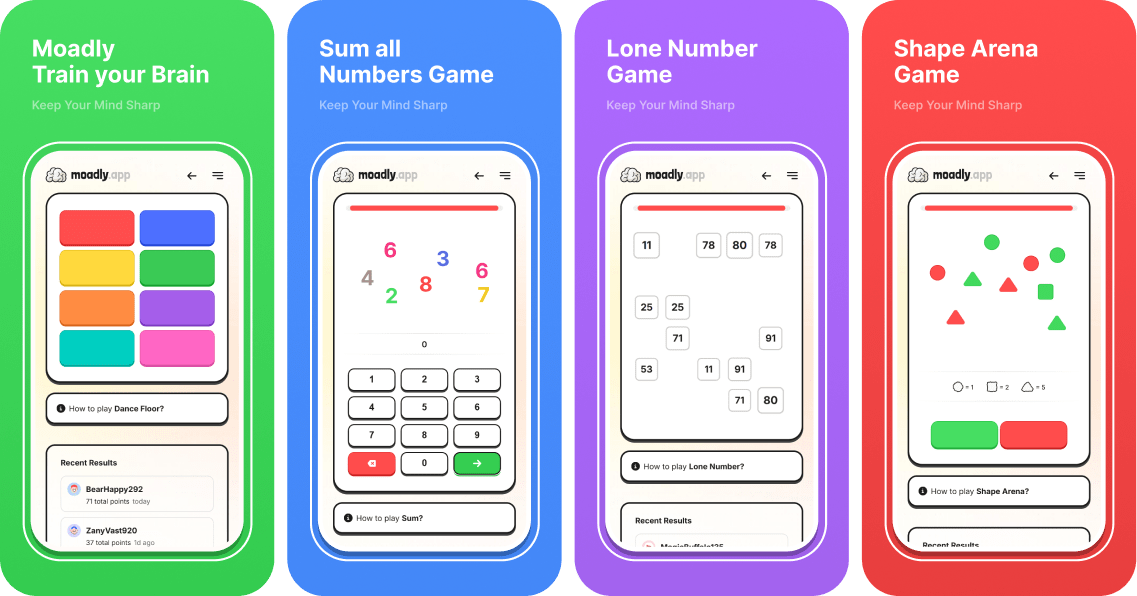
Why moadly was built differently
This is the contrast that matters.
Moadly was built with the assumption that most brain apps fail users by design.
So the priorities were reversed:
- Protect focus instead of interrupting it
- Repeat core skills instead of chasing novelty
- Adapt difficulty instead of inflating it
- Measure consistency instead of clicks
No interstitial ads. No fake progress. No endless mode switching.
Just short, focused sessions that respect how the brain actually adapts.
The data most apps never show
Moadly publishes real user trends at https://moadly.app/survey/.
The patterns are not glamorous, but they are honest:
- Attention improves first
- Memory follows with repetition
- Consistency matters more than session length
This aligns with everything we know about learning and neuroplasticity.
Why this truth is uncomfortable
Because it means:
- Most popular brain apps are not broken. They are misaligned
- Feeling smart is not evidence of improvement
- Progress takes longer than marketing promises
It also means responsibility shifts back to the user to choose better tools.
How to spot a brain app that will disappoint you
Ask yourself:
- Does it interrupt focus with ads
- Does difficulty come from speed instead of thinking
- Is progress measured beyond points and levels
- Does it repeat core skills or constantly reinvent itself
If the answers are not reassuring, the app is probably built to entertain you, not train you.
The uncomfortable conclusion
Most brain apps are not lying. They are just selling the wrong thing.
They sell stimulation as training. Engagement as improvement. Novelty as progress.
Your brain does not need more excitement. It needs consistent, focused signals.
If an app respects your attention, values repetition, and accepts that progress is quiet, it is probably worth your time.
If it constantly tries to impress you, it probably has nothing real to offer.
The uncomfortable truth is simple. Your brain deserves better than clever distractions dressed up as science.
Choose tools that work, not tools that perform.