Why focus cannot be hacked quickly
If you have ever typed the same password three times and still got it wrong, or opened a tab and instantly forgot why you opened it, welcome. That is not you being broken. That is modern life gently chewing on your attention every single day.
Memory and focus are deeply linked. People love to treat them like separate switches you can flip. Focus on. Memory on. In real life it does not work like that. Focus is more like a muscle that responds to consistent pressure, not sudden hacks. Memory grows in the same soil.
I am going to talk honestly here. No miracle tricks. No five second fixes. Just what actually works, why it works, and how tools like moadly.app fit into real routines without pretending to be magic.
First, let us kill the myth of the quick hack
There is a whole internet economy built on the idea that you can unlock your brain in minutes. Drink this. Tap that. Listen to a frequency while sleeping. It sounds tempting, especially when your brain feels foggy and slow.
But the uncomfortable truth is simple. Focus cannot be hacked quickly because the brain does not learn under shortcuts. It adapts through repetition, challenge, and recovery.
If you want proof, look at attention training research or even basic skill learning. You do not become fluent, sharp, or mentally calm overnight. You build it.
This is explained really well in how brain games stimulate neuroplasticity and focus. Neuroplasticity is not fireworks. It is construction work.
Why your memory feels worse than it used to
Most people assume memory decline means intelligence loss. That assumption is wrong and unnecessarily scary.
Here are the real usual suspects.
- Chronic distraction. Notifications train your brain to never fully encode information.
- Low quality focus. Reading while scrolling is not reading.
- Mental fatigue. Burnout does not erase memory. It blocks access to it.
- No retrieval practice. Memory strengthens when you recall, not when you re-read.
If this sounds familiar, you will probably relate to how to stop being so forgetful. Forgetfulness is usually environmental, not permanent.
Focus is the gatekeeper of memory
Here is a simple truth that changes how you train your brain.
If you do not focus when information enters, memory has nothing to store.
That is why attention training is not optional. It is foundational. This is also why games that require sustained attention outperform passive activities.
There is a great breakdown in the importance of attention training in brain fog recovery. Focus is the filter that decides what becomes memory.
What actually improves memory long term
Let us get practical. Below are the methods that consistently work when people stick with them.
1. Active recall instead of passive exposure
Re-reading feels productive. It is not. Trying to remember without looking is where growth happens.
Memory strengthens when it struggles a little.
This is why thinking games, quizzes, and timed challenges work better than scrolling through information.
2. Short, frequent mental challenges
You do not need hour long sessions. You need consistency.
| Approach | Effect on memory |
|---|---|
| 5 minutes daily | Builds habit and attention stamina |
| 30 minutes once a week | Low retention and poor transfer |
This is why daily brain games matter more than intensity. Daily brain games to wake up your mind explains this nicely.
3. Speed plus accuracy
Memory improves faster when the brain is slightly pressured. Not stressed. Just challenged.
Fast paced games force your brain to encode quickly and retrieve under time limits. That is how real life works.
If you like that style, fast paced brain training game that keeps your mind active is worth checking out.
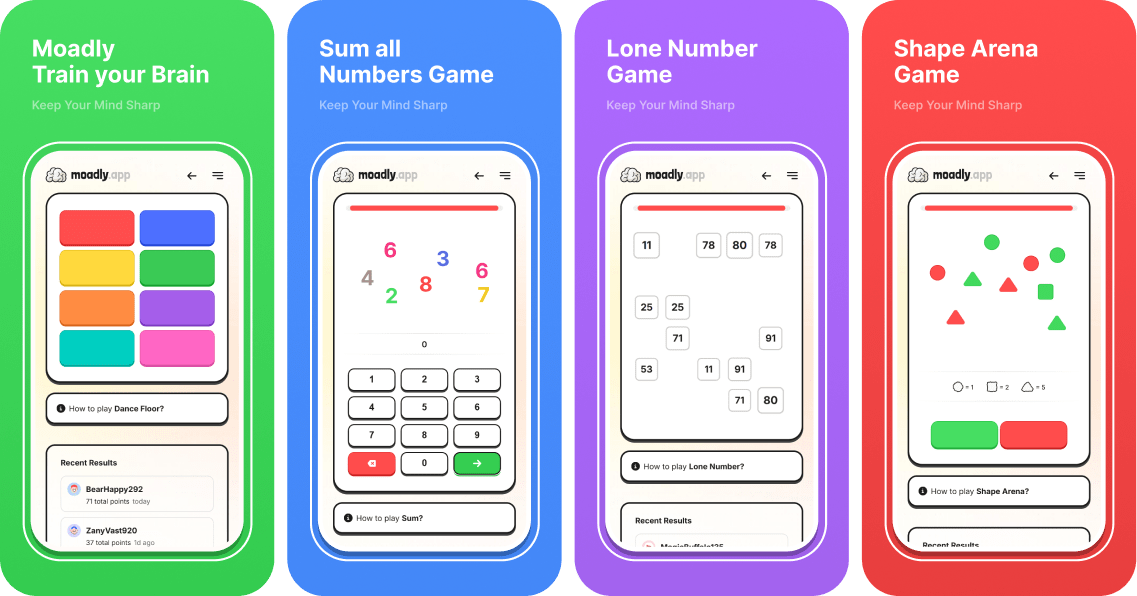
Where moadly.app fits into this
Let us be honest about brain apps for a second. Most of them fail because they are either boring, too easy, or gimmicky.
What moadly.app does well is balance three things.
- Short sessions that do not feel like homework
- Real cognitive load instead of fake progress
- Variety so your brain does not go on autopilot
This matters because the brain adapts quickly. If the challenge stays the same, growth stops.
There is a broader overview in best websites and apps to help keep your brain sharp and focused, but moadly stands out for one reason. It respects your time.
Memory training across different ages
Memory training is not age specific. The approach just changes slightly.
For adults juggling too much
The goal is not max performance. The goal is mental clarity.
Logic games, fast reading challenges, and attention tasks work well here. thinking games to improve logic and focus goes deeper into this.
For seniors
Consistency beats difficulty. Games that train recall, pattern recognition, and number sense are ideal.
See free brain games for seniors that actually help memory for examples that do not feel patronizing.
For kids and teens
Fun matters. If it feels like school, it fails.
Educational games that disguise learning are powerful. top educational games for kids to boost learning at home shows why playful challenge wins.
Brain fog is not the enemy, it is a signal
Brain fog scares people. It feels like your mind is slipping. In reality, it is often your brain asking for better inputs.
Common causes include poor sleep, information overload, and lack of focused stimulation.
If you are dealing with this, these are worth reading.
- how to fix brain fog asap
- how to clear brain fog in 5 minutes
- what do doctors recommend for brain fog
Notice the pattern. None of them promise permanent fixes in minutes. They focus on reducing overload and rebuilding focus.
Why the 100 percent brain myth refuses to die
You have probably heard this one. We only use 10 percent of our brain. Unlock the rest.
It is false. Completely.
What we actually underuse is deep attention. That is what people feel when they say they want full brain power.
If you are curious, how can we unlock the 90 of our brain that we never use breaks down why this myth persists.
Simple daily structure that works
No aesthetic routines. No extreme discipline. Just realistic structure.
- 5 to 10 minutes of focused brain training
- One distraction free task right after
- One moment of recall later in the day
That is it. That combination trains focus, encoding, and retrieval.
If you want ideas for what to play, best free brain games to play right now is a solid starting point.
Why consistency beats motivation
Motivation fades. Habits stay.
This is why tools like moadly.app work best when you treat them like brushing your teeth. You do not wait to feel inspired.
Memory grows quietly. You notice it later.
You notice when names come back faster. When reading feels smoother. When focus stops feeling fragile.
.png)
Final thought
If focus could be hacked quickly, nobody would be distracted. The fact that it cannot is not a flaw. It is protection.
Your brain is designed to change slowly so it does not break under noise. Respect that pace. Train it gently. Challenge it consistently.
That is how memory actually improves. Not overnight. But for real.