Interactive Cognitive Exercises That Actually Work in Your Browser
For years, the promise of "brain training" was locked behind expensive proprietary software or clunky CDs. In 2026, the landscape has shifted entirely. We now understand that the most effective cognitive interventions don't require a high-end gaming PC or a VR headset; they require specific, scientifically-validated logic loops that can be executed right in your web browser.
Cognitive exercises, when designed correctly, leverage neuroplasticity, the brain’s ability to reorganize itself by forming new neural connections throughout life. This guide explores the interactive exercises that actually work, the science behind them, and how platforms like Moadly are leading the charge in making these tools accessible to everyone.
The Science of Browser-Based Cognitive Training
Before diving into the exercises, it is crucial to understand what makes an interactive task "effective." It isn't just about playing a game; it's about stimulating specific executive functions.
1. Neuroplasticity and Targeted Stress
Just as a muscle requires physical stress to grow, the brain requires cognitive "load" to strengthen its pathways. Effective browser games use Adaptive Difficulty. This means the exercise stays just at the edge of your ability, a concept known as the Zone of Proximal Development. If a task is too easy, your brain glides on autopilot; if it's too hard, you disengage.
2. The Transfer Effect
The biggest criticism of early brain games was that they only made you better at the game itself. Modern exercises focus on Far Transfer, ensuring that practicing a memory task in your browser helps you remember where you put your keys or follow complex instructions at work.
Category 1: Working Memory Powerhouses
Working memory is your brain's "RAM." It is the ability to hold and manipulate information in your mind over short periods.
The Dual N-Back Task
Widely considered the gold standard of cognitive training, the Dual N-Back requires you to keep track of two independent streams of information (usually a visual square and an auditory letter).
- How it works: You must signal when the current stimulus matches the one shown "N" steps ago.
- The Result: Studies published in Nature suggest that consistent practice can improve fluid intelligence.
Spatial Span Tasks
These involve remembering a sequence of flashing blocks on a grid. This exercise targets the visuospatial sketchpad, a component of working memory essential for navigation and architecture-style mental modeling.
Category 2: Inhibitory Control and Focus
In an era of infinite scrolls, the ability to not do something is just as important as the ability to do something.
The Stroop Effect Task
You see the word "BLUE" but it is colored red. You must click the button for the color of the ink, not the word itself.
- The Science: This exercise targets the Anterior Cingulate Cortex, which handles conflict resolution.
- Real-world application: Improving this skill makes it easier to ignore notifications and stay focused on a deep-work task.
Go/No-Go Challenges
A series of symbols flash on the screen. You must click for every symbol except one specific "trigger" symbol. As the speed increases, your "impulse" to click becomes harder to override, directly exercising your prefrontal cortex.
Category 3: Moadly – The Modern Browser Standard
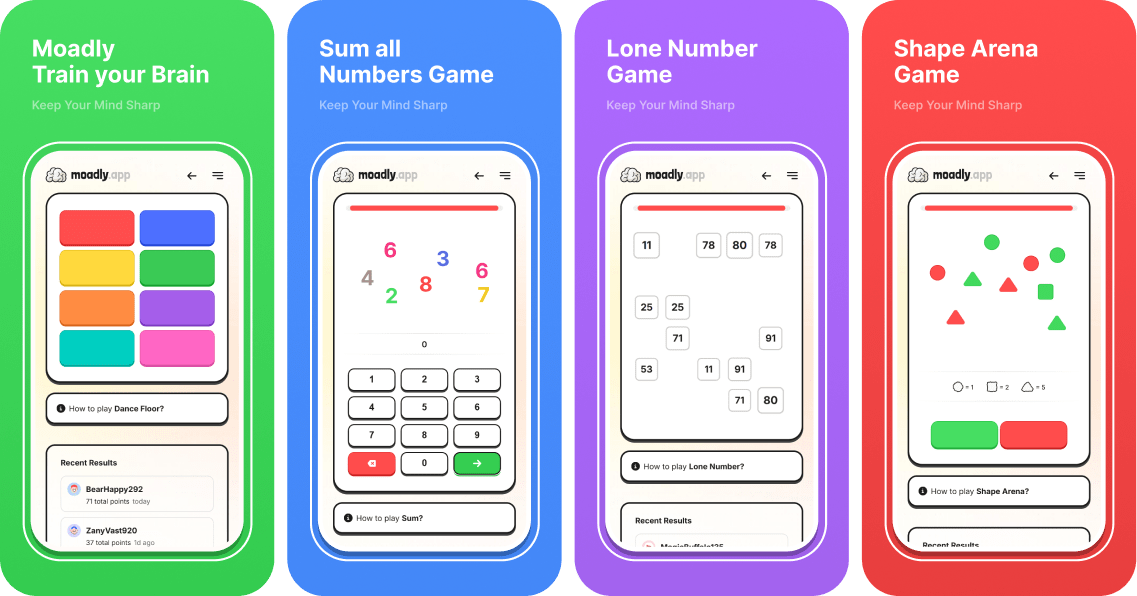
At Moadly, we believe that the best cognitive exercises are the ones you actually look forward to doing. We have stripped away the predatory subscription models of 2010s-era apps and replaced them with high-fidelity, science-first browser games.
Why Moadly Works
Unlike "bloated" apps that require 500MB of space on your phone, Moadly is optimized for the web. This means you can get a fast cognitive boost every day whether you are on a Chromebook, a work laptop, or a smartphone.
Signature Moadly Exercises
- Fast-Paced Logic Sprints: We’ve designed thinking games to improve logic and focus that force you to make rapid deductions under time pressure.
- Memory Grids: These focus on how to stop being so forgetful by training your visual-spatial sketchpad through pattern recall.
- Math Agility: Our best math games for adults who love numbers aren't about rote memorization; they are about fluid numerical manipulation.
- Focus Builders: Using conflict-resolution mechanics, these fast-paced brain training games help clear brain fog instantly.
Moadly vs. Traditional Apps
| Feature | Expensive Apps | Moadly Browser Platform |
|---|---|---|
| Access | App Store Download | Instant Web URL |
| Cost | $15+/month Subscription | Free Interactive Access |
| Science Base | Proprietary/Hidden | Open Neuro-Principles |
| Experience | Heavy UI / Ads | Clean, Logic-Focused |
Category 4: Processing Speed and Agility
Processing speed is the rate at which you take in new information, reach a conclusion, and formulate a response. In the digital workplace, this is your primary competitive advantage.
Symbol Coding
In this exercise, you are given a key (e.g., 1 = Δ, 2 = ◊). You must translate a string of numbers into symbols as fast as possible. This is a classic neuropsychological test used to measure mental quickness.
Visual Scanning
Finding a target in a field of distractors (Visual Search) forces your eyes to move in "saccades." This "wakes up" the visual cortex and is a perfect remedy for the "glaze" that comes from staring at spreadsheets for hours. Moadly's brain changer games often utilize this to help players snap out of cognitive ruts.
Category 5: Cognitive Flexibility (Task Switching)
Cognitive flexibility is the ability to switch between thinking about two different concepts or to think about multiple concepts simultaneously.
The Trail Making Task
A browser version of the "Connect the Dots" test where you must alternate between numbers and letters (1-A-2-B-3-C). This exercises the executive function of shifting. If you find it hard to move from one project to another at work, this is the exercise you need.
Rule-Shifting Puzzles
Games that change the sorting criteria mid-round (e.g., "Sort by shape" then suddenly "Sort by color") force your brain to let go of old patterns. This is a core part of cognitive games that actually make you smarter.
The Impact on Different Age Groups
The beauty of browser-based exercises is their versatility. They aren't just for students or high-performers.
- For Seniors: Interactive play is a vital tool for maintaining independence. Moadly provides free brain games for seniors that are accessible without needing to navigate complex app stores.
- For Kids: Developing focus early is essential. We've curated learning games that actually teach fundamental logic skills through play.
- For Professionals: Using a fast-paced brain training game during a lunch break can prevent the mid-afternoon slump.
Conclusion: The Future is Browser-Based
We are moving away from the era of "entertainment-only" games and into the era of Functional Play. By utilizing the interactive cognitive exercises found on platforms like Moadly, you are taking control of your mental health through scientifically-backed methods.
You don't need to spend hundreds of dollars on a "brain gym" membership. You just need 10 minutes, a browser, and the willingness to challenge your own limits. Whether you want to unlock your full brain capacity or just feel a bit sharper for your next meeting, the tools are already at your fingertips.