Why puzzles alone do not improve intelligence
Here’s a truth that surprises a lot of people: doing puzzles does not make you smarter. Not really. It can make you feel sharp in the moment, but long term cognitive improvement? That’s a different story.
Puzzle games are fun. They are satisfying. They give instant feedback and small wins. But they are extremely limited in what they train. If your goal is true intelligence improvement, you need more than matching shapes or solving riddles.
Most apps are just puzzle games in disguise
When you open a “brain training” app, count how many times you see:
- Pattern matching
- Memory sequence repetition
- Sudoku or crossword clones
These are puzzles. And puzzles alone do not build general intelligence. They improve task-specific skills, which is why people think they’re getting smarter. But solving a match-three puzzle faster doesn’t improve your reasoning in a meeting or your memory for names.
Real intelligence training relies on tasks that encourage:
- Working memory development
- Attention and focus
- Problem-solving with transfer to daily life
Check out which games actually boost IQ to see what that looks like in practice.

Puzzles are not complicated enough
Puzzles increase difficulty by adding more pieces or faster timers. Your brain adapts quickly. Once the pattern is familiar, it stops requiring real effort. You’re just repeating a learned trick, not growing your cognitive capacity.
Intelligence growth needs adaptive complexity, not predictable escalation. Moadly games, for example, adjust difficulty based on attention, memory, and reasoning performance, not just “faster is harder.”
Ads ruin cognitive flow
One of the silent killers of puzzle apps is monetization. Banner ads, popups, interstitials, and rewarded videos break focus constantly.
Intelligence isn’t built in fragments. Every interruption—especially in the middle of a puzzle—forces your brain to switch contexts, breaking working memory and attention. This is why people feel “tired” after short sessions of ad-filled puzzle apps.
Interstitial ads are destructive
Interstitials are particularly brutal. They pause your session entirely, forcing your attention away from the puzzle. Even if you finish it later, the cognitive effort was wasted. Your brain remembers the interruption more than the exercise.
Moadly avoids this entirely. You focus uninterrupted, which is the only way to build skills that transfer to real life.
What actually improves intelligence
True intelligence growth comes from combining multiple cognitive domains, not isolated puzzle practice:
- Attention control – train focus to improve how information is absorbed and maintained
- Working memory – juggling multiple pieces of information at once
- Logic and reasoning – solving novel problems that aren’t predictable
- Consistency and adaptive difficulty – steadily increasing challenge without burnout
- Real-life application – transferring learned skills to everyday tasks
See why daily micro sessions in daily brain games to wake up your mind are more effective than hour-long puzzle marathons?
Why most people give up
Even with good intentions, puzzle-only apps fail because:
- Progress feels artificial and confined to the app
- No connection to daily cognitive performance
- Motivation fades when results don’t transfer
Users often search for answers like how to unlock more of their brain, only to realize puzzles alone cannot do it.
Shill time: why moadly.app does it differently
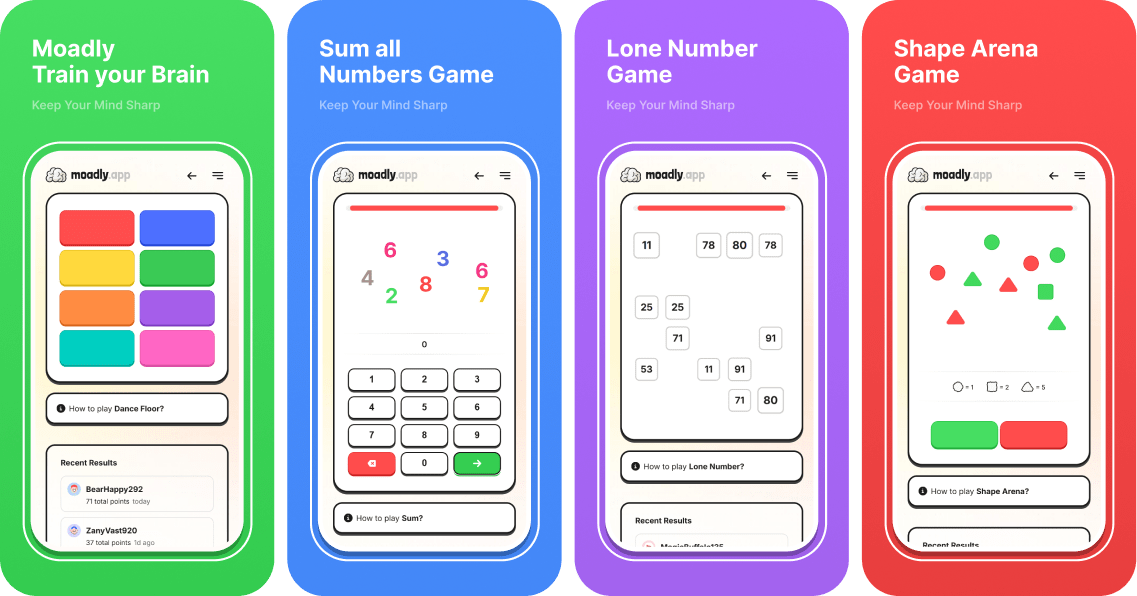
Unlike puzzle apps, moadly.app combines:
- Attention, memory, and reasoning tasks in one session
- Adaptive difficulty based on your actual performance
- No interstitial ads breaking focus
- Progress tracking tied to real cognitive improvements
This is why our case study https://moadly.app/survey/ shows consistent users improve measurable cognitive performance over weeks, not just app scores.
Kids, adults, and seniors need different stimuli
One-size-fits-all puzzle apps fail across age groups:
- Kids need novelty and fun logic games (educational games for kids)
- Adults need efficient sessions targeting focus, memory, and problem-solving (websites and apps for focus)
- Seniors need clear, low-friction cognitive exercises (brain games for seniors)
Using the same puzzle for all groups is like expecting the same workout for a teen, a marathon runner, and a retired athlete. It doesn’t work.
Summary
Puzzles alone are fun. They are satisfying. But they do not improve intelligence long term because:
- They train task-specific skills, not general cognitive capacity
- They fail to adapt to real cognitive growth
- Ads and interruptions break attention and working memory
- Motivation fades when progress feels artificial
True intelligence improvement requires a system that integrates attention, memory, reasoning, and consistency, and respects your focus. That’s exactly why moadly.app exists and why our users see real results that extend beyond the app itself.
Stop wasting time on flashy puzzles that only make you feel smart for five minutes. Engage in exercises that build actual mental power, and your brain will thank you later.